What is Adaptive Authentication and How Does It Work?
September 21, 2026

September 21, 2026
The digital era got to a stage where business’s sensitive data is constantly under threat, and the traditional passwords you rely on are no longer enough to protect it.
As an IT manager or security professional, you know it’s time to rethink how we secure our systems.
Traditional authentication methods, like passwords and even two-factor authentication, are showing their limitations. A recent report by Verizon Business pointed out that 81% of data breaches involve weak or stolen passwords.
Your organization needs a solution that adapts to modern threats and keeps your data secure without compromising user experience. Adaptive authentication might just be what you’ve been looking for.
This innovative approach assesses various factors—such as location, device, and user behavior—to provide a dynamic, context-aware layer of security. Adaptive authentication requirements reinforce security while providing a greater experience for legitimate users.
In this article, we’ll delve into the benefits of adaptive authentication, explore its various applications, and show how V2 Cloud’s solution can help you protect your organization against today’s sophisticated cyber threats.
Adaptive authentication is an advanced security method that enhances traditional authentication techniques by evaluating multiple contextual factors in real time to assess the legitimacy of access attempts.
Unlike static passwords or even standard two-factor authentication (2FA), adaptive authentication dynamically adjusts based on the risk profile of each login attempt.
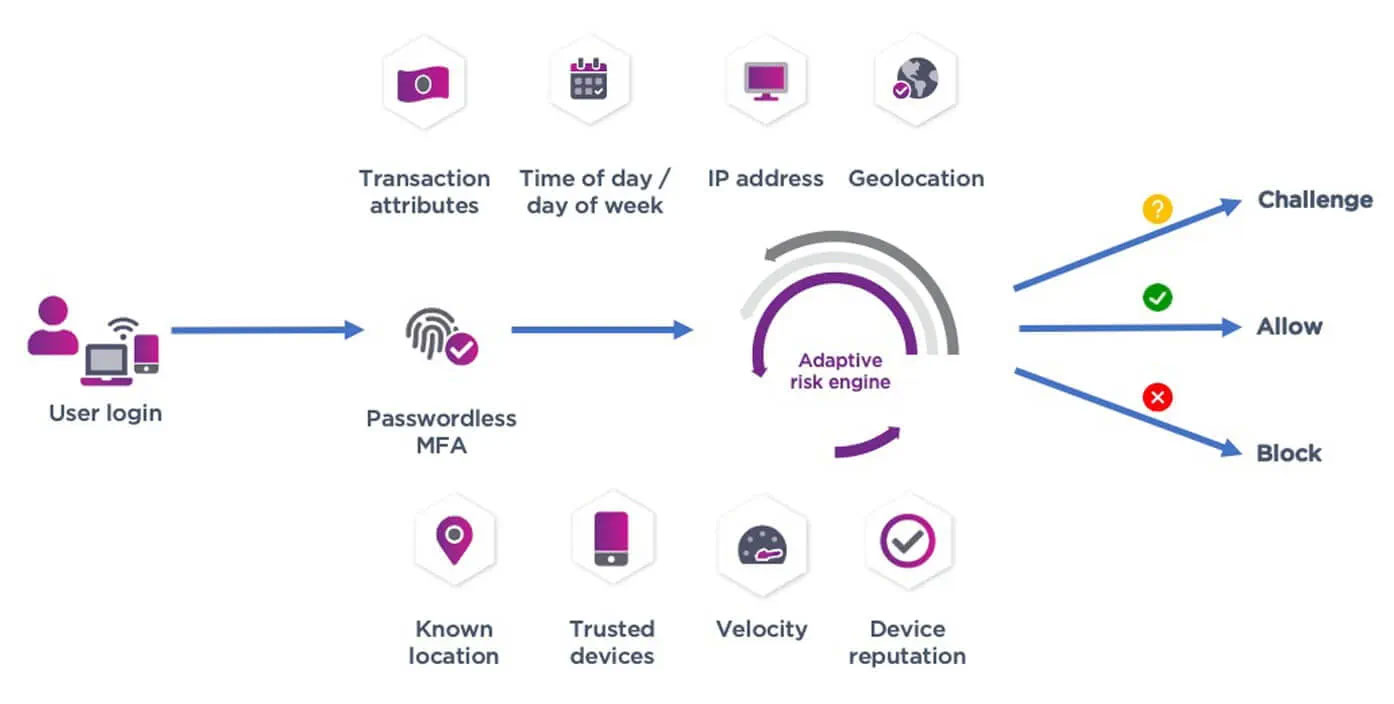
By dynamically adjusting the security requirements based on the risk assessment, adaptive authentication provides a higher level of security while minimizing disruptions for legitimate users.
This intelligent approach ensures that only trusted users gain access, significantly reducing the chances of unauthorized entry.
When a user attempts to log in, the system collects data from multiple sources to create a comprehensive profile of the access attempt.
Each contextual factor is assigned a risk score. The cumulative risk score determines the level of authentication required.
The system continuously learns from each interaction, improving its ability to distinguish between legitimate users and potential threats.
If a legitimate user is flagged, the system adapts by adjusting risk thresholds or recognizing new patterns, ensuring a balance between security and user convenience.
Adaptive authentication employs a variety of techniques and methods to enhance security by continuously evaluating the risk associated with each login attempt.
These methods go beyond traditional passwords and two-factor authentication (2FA), incorporating real-time data analysis and machine learning to make informed security decisions.
MFA requires users to provide two or more verification factors to gain access.
These factors typically include something the user knows (password), something the user has (smartphone), and something the user is (biometric data).
Behavioral biometrics analyze patterns in user behavior, such as typing speed, mouse movements, and touchscreen interactions.
This technique involves identifying and verifying the devices used for login attempts. Known devices are flagged as safe, while new or unrecognized devices may trigger alerts.
Geolocation checks the physical location from which a login attempt is made.
This method analyzes the network and IP address from which the login attempt originates.
The time-based analysis considers the timing of login attempts.
Machine learning algorithms analyze large sets of data to identify patterns and make predictions.
Adaptive authentication is crucial for modern businesses to protect against sophisticated cyber threats. Many solution providers offer advanced features tailored to various industries’ needs.
Here are the top 10 adaptive authentication solution providers that stand out in the market today.
Azure AD is a cloud-based identity and access management service from Microsoft that provides robust adaptive authentication features.
Key Features:
Okta is a leading identity management platform that simplifies secure access for employees, partners, and customers.
Key Features:
IBM Security Verify offers a scalable and flexible identity and access management solution with strong adaptive authentication capabilities.
Key Features:
RSA SecurID is a trusted name in authentication, providing a robust solution for identity assurance and adaptive authentication.
Key Features:
Duo Security, part of Cisco, offers a user-friendly adaptive authentication platform that ensures secure access for organizations of all sizes.
Key Features:
Ping Identity provides intelligent identity solutions designed to secure enterprise environments with adaptive authentication.
Key Features:
SecureAuth focuses on adaptive authentication and identity security to protect against unauthorized access and fraud.
Key Features:
OneLogin provides a unified access management platform with advanced adaptive authentication capabilities.
Key Features:
Auth0, now part of Okta, offers a flexible identity platform that simplifies adaptive authentication for developers and businesses.
Key Features:
V2 Cloud is a Virtual Desktop Infrastructure (VDI) solution that offers adaptive authentication to ensure secure access to virtual desktops and applications. It’s your one-stop shop for creating a highly secure virtual work environment.
Key Features:
Adaptive authentication offers an extra layer of security by continuously analyzing various factors to assess the risk of each login attempt.
Unlike static methods, which rely on fixed credentials, adaptive authentication evaluates dynamic data such as user behavior, device information, location, and network context.
This comprehensive analysis makes it significantly harder for attackers to bypass security measures, as multiple aspects must align for successful access.
Adaptive authentication greatly improves the user experience by reducing the need for repeated authentication during low-risk activities.
Traditional methods often require users to re-enter passwords or complete MFA for every access attempt, which can be tedious and time-consuming.
Adaptive authentication evaluates the risk associated with each login attempt and only prompts for additional verification when necessary. This approach ensures that users can access their accounts seamlessly for routine tasks, leading to a smoother and more efficient experience.
One of the key benefits of adaptive authentication is its ability to adapt in real time to emerging threats and anomalies.
The system continuously learns from each interaction, improving its accuracy in distinguishing between legitimate users and potential attackers.
If unusual activity is detected, adaptive authentication can immediately enforce additional security measures, such as requiring MFA or blocking access entirely.
Adaptive authentication is highly scalable, making it suitable for businesses of all sizes. Whether a small startup or a large enterprise, organizations can tailor adaptive authentication solutions to fit their specific needs.
The flexibility of adaptive authentication allows it to integrate seamlessly with existing systems and infrastructure, providing a cost-effective way to enhance security.
As businesses grow and their security needs evolve, adaptive authentication can scale accordingly, ensuring consistent protection across all levels of the organization.
Adaptive authentication plays a crucial role in protecting sensitive company data from unauthorized access.
This dynamic approach is particularly valuable for businesses dealing with confidential information, intellectual property, and internal communications, providing robust security without disrupting workflow. Platforms like Adaptive Security can complement these efforts by training employees to recognize AI-powered social engineering attacks, adding a human layer of defense alongside technical authentication controls.
Adaptive authentication helps prevent fraud by assessing the risk of each access attempt in real time. Factors such as transaction patterns, geolocation, and device security are evaluated to ensure that access is granted only to verified users.
This method enhances the security of online banking, investment platforms, and other financial services, protecting customers and institutions from cyber threats.
Healthcare organizations handle vast amounts of sensitive patient records and must comply with strict regulations like HIPAA.
Adaptive authentication helps protect patient data by continuously monitoring access attempts and adjusting security measures based on risk.
It ensures that only authorized healthcare professionals can access medical records, reducing the risk of data breaches. This approach supports compliance with regulatory requirements and safeguards patient privacy.
E-commerce platforms are prime targets for cyber-attacks due to the high volume of online transactions and customer data.
Adaptive authentication enhances the security of these platforms by evaluating various factors such as user behavior, device integrity, and transaction patterns.
It helps prevent unauthorized access and fraudulent transactions, ensuring that legitimate customers have a smooth shopping experience while keeping their data secure.
Implementing adaptive authentication is easy with V2 Cloud. Our Virtual Desktop Infrastructure solution seamlessly integrates with your existing systems, offering robust security without the hassle of a complex setup.
V2 Cloud continuously monitors user behavior, device security, and contextual factors, adjusting authentication requirements in real time. This ensures low-risk activities proceed seamlessly, while high-risk attempts trigger additional verification.
With V2 Cloud, administrators can easily manage security policies through an intuitive interface, and end-users enjoy a smooth, secure login process. Our scalable solution adapts to your business’s evolving security needs, providing a one-stop shop for your business’s cybersecurity.
Talk to our experts to learn more about how we can help your company!
Your V2 CloudCare team — real people, on the line.