Cloud Computing AI: How It Works, Benefits & Solutions - V2 Cloud
October 5, 2026

October 5, 2026
Businesses that hesitate to adopt cloud computing AI are at risk of falling behind. The absence of these advanced technologies can lead to inefficiencies, slower decision-making processes, and missed opportunities in a highly competitive market.
Embracing cloud computing AI is not just about staying relevant; it’s about unlocking a myriad of possibilities that transform operations, drive innovation, and significantly reduce operational complexities.
With a global market size exceeding 200 billion U.S. dollars in 2023, AI has become a pivotal technology across industries, revolutionizing how businesses operate and enhancing our daily lives. As these technologies merge, they unlock unprecedented efficiencies, capabilities, and scalability opportunities for enterprises — much like how tools that merge PDF documents streamline digital workflows by combining multiple files into a single, manageable format.
V2 Cloud is leading this transformation, enhancing our Virtual Desktop Infrastructure (VDI) solutions with AI to provide robust, scalable, and seamless computing experiences.
We empower businesses to leverage these advanced technologies for significant competitive advantages, driving innovation and operational excellence in the cloud.
Artificial Intelligence (AI) and cloud computing are distinct yet increasingly interconnected technologies that are pivotal in driving the next wave of digital transformation. AI refers to the capability of machines to perform tasks that typically require human intelligence.
This includes processes like learning, reasoning, problem-solving, perception, and language understanding through disciplines such as machine learning and neural networks.
Cloud computing, on the other hand, involves delivering various services over the Internet, including data storage, servers, databases, networking, and software. Cloud computing’s key attribute is its ability to provide scalable access to computing resources and IT services.
When integrated, AI and cloud computing create a powerful synergy. Cloud environments enhance AI by providing the vast data storage and high-speed computing necessary to train sophisticated machine learning models without the need for significant upfront investment in physical infrastructure.
Involves algorithms that parse data, learn from it, and then apply what they have learned to make informed decisions. Machine learning models run on cloud platforms can continually improve their performance as they process more data over time.
Inspired by the human brain, these networks are a series of algorithms that identify underlying relationships in a set of data through a process that mimics the way the human brain operates. Neural networks are particularly effective at processing patterns and data in complex scenarios, making them useful for tasks ranging from speech recognition to weather forecasting. In production environments, this is exactly what powers automatic speech recognition ASR, where cloud-hosted neural networks transcribe multilingual speech in real time at scale.
AI enhances data analytics by providing deeper, more accurate insights into both structured and unstructured data. This capability is integral to cloud-based AI tools, including features like an AI voice generator for interactive applications, helping businesses analyze massive volumes of data to make strategic decisions. In content-focused workflows, tools like Humanize AI can refine AI-generated drafts into more natural, human-like text, helping teams produce polished content more efficiently.
Several foundational technologies are employed to integrate AI with cloud computing effectively. These technologies not only facilitate the smooth operation of AI applications but also ensure their scalability, efficiency, and adaptability across diverse cloud environments:
They provide isolated environments that enhance the scalability and portability of AI applications across various cloud infrastructures. This isolation helps maintain consistent performance and security standards regardless of the underlying hardware.
Critical for AI’s data-driven nature, these platforms enable the efficient storage, processing, and analysis of vast datasets used by AI developers. AI models depend on these platforms for accessing and learning from large amounts of data, essential for accurate predictions and decision-making. A data ontology complements these capabilities by organizing data into a shared semantic structure, helping AI models better understand relationships between data points, improve interoperability, and produce more reliable results.
Tools like TensorFlow and PyTorch are indispensable for developers building AI solutions, enabling rapid model development and deployment within cloud environments. These frameworks support the design, training, and deployment of neural networks within cloud environments, providing the necessary infrastructure to handle complex computations.
APIs are crucial for integrating AI functionalities into cloud platforms. They enable seamless communication between disparate AI and cloud services, facilitating a cohesive environment where applications can share data and functionalities efficiently and securely.
Integrating AI with cloud computing brings several significant advantages that can transform businesses’ operations and scale.
AI automates routine tasks and optimizes the allocation and use of cloud resources, which significantly reduces manual effort and improves operational efficiency.
AI-driven predictive analytics enable dynamic scaling, allowing cloud systems to automatically adjust resources based on anticipated demand. This ensures performance stability and cost-effectiveness without human intervention.
The integration of AI facilitates the faster deployment of new solutions and services. By automating complex processes and analyses, AI allows organizations to quickly innovate and respond to market changes or internal demands.
AI enhances decision-making processes by providing analytics and insights derived from large datasets that humans may not be able to process effectively. This can lead to more informed and data-driven decisions.
By automating various tasks, especially those related to data management and analysis, AI can help reduce operational costs. It minimizes the need for physical hardware, reduces labor costs, and optimizes cloud resource usage to prevent over-provisioning. As AI workloads scale across GPUs and managed services, many teams adopt finops for AI to maintain cost efficiency through better spend visibility, attribution, and governance.
AI can improve security within cloud environments by automatically detecting and responding to threats in real-time. It can identify unusual patterns that may indicate a security breach and take preventive actions without human intervention.
AI can help organizations comply with various regulations by automatically ensuring that data handling and processing meet legal requirements. It can also keep logs and records of all activities to aid in audits.
Integrating AI into existing cloud infrastructures requires strategic planning, consideration of potential challenges, and adherence to best practices to ensure success.
As AI continues to evolve alongside cloud computing, we are on the brink of witnessing transformative changes across various industries. Here are some key insights and predictions:
As AI continues to integrate with cloud computing, the potential for transformative business solutions grows exponentially. The synergistic relationship between these technologies is paving the way for enhanced efficiency, greater scalability, and accelerated innovation across all sectors.
Businesses that leverage AI-enhanced cloud computing are positioned not only to thrive in their current markets but also to lead in the creation of new ones. V2 Cloud is committed to driving these advancements forward, ensuring that our clients are equipped with the most advanced, secure, and efficient VDI solutions available.
Embracing AI and cloud computing is no longer just an option but a strategic imperative for businesses aiming to remain competitive in a rapidly evolving digital landscape.
V2 Cloud is one of the leading cloud providers – we stand out as the preferred Virtual Desktop Infrastructure (VDI) provider for several compelling reasons:
Transform your business operations with the integration of AI in cloud computing. V2 Cloud’s AI-enhanced VDI solutions deliver a smarter, more secure, and highly scalable computing environment tailored to your needs.
Talk to a Cloud Expert Today to begin leveraging the advanced capabilities of AI and cloud computing.
Experience firsthand how our customized VDI solutions can drive your business strategies forward, optimizing performance and innovation at every level.
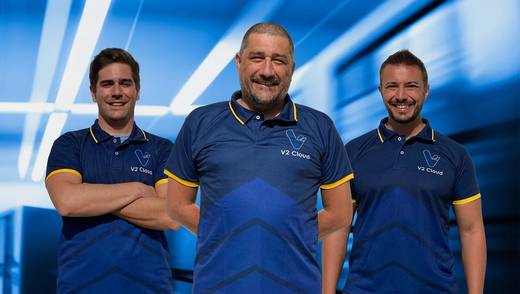
Your V2 CloudCare team — real people, on the line.


