Distributed Workforce Management in 2026: Industry Report for Business Leaders
September 21, 2026

September 21, 2026
Distributed workforce management in 2026 is defined by one uncomfortable reality: most organizations are still running workforce infrastructure built for a model that no longer exists.
HR leaders and line-of-business managers are simultaneously navigating AI adoption, evolving leadership expectations, skills shortages, expanding compliance obligations, and increasingly distributed employment models. These are not separate problems. They share a common root.

The question organizations were asking two years ago, whether to adopt AI, has been replaced by a more complex one: how do you operationalize AI responsibly across functions that handle some of the most sensitive data in the organization?
A Gartner survey of CHROs conducted in October 2025 identified AI adoption in HR as the single top priority for 2026. AI is now embedded across core HR functions.
Talent acquisition, resume screening, candidate matching, employee onboarding, learning and development, workforce planning, performance management, and analytics are all being touched by AI-driven tooling.
The productivity gains are real. So are the risks. The organizations furthest ahead on AI adoption are also the ones most exposed to governance failures.
When AI systems access, process, and learn from that data, the governance questions become immediate: who has access, where does the data live, how is it audited, and what happens when a regulator asks.
Crucially, the financial stakes are significant. The average cost of a data breach for U.S. companies reached a record $10.22 million USD in 2025.
Organizations that deploy AI tools across distributed, unmanaged endpoints create governance gaps that policies alone cannot close. Data moves to devices that IT cannot see, cannot control, and cannot recover cleanly when an employee leaves.
Centralized computing environments address this structurally. When applications and data live on servers rather than local machines, AI-related activity is logged at the server level. Access is controlled by identity, not by device. Data does not travel to endpoints it was never supposed to reach.
AI governance in 2026 is an infrastructure question as much as a policy question. The V2 Cloud security and compliance framework and AI agents give IT administrators granular control over what users can access, move, copy, or transfer within a cloud desktop environment. They operate within that controlled layer, giving organizations the audit trail and access controls that distributed endpoint models cannot provide.
The organizations succeeding in this environment share one characteristic: their leaders spend time on people, not on technology troubleshooting. When the underlying technology environment is inconsistent, fragmented, or unreliable, leadership capacity is consumed by operational friction.
An employee in one location cannot access the same applications as a colleague in another. A new hire’s environment is misconfigured and their first week is spent waiting for IT. A distributed team runs different versions of core tools because device management is inconsistent across regions.
Desktop as a Service (DaaS) removes the technology consistency problem from the leadership equation. Every employee, regardless of location or device, accesses the same environment. Same applications, same performance, same data.
Our 99.95% uptime SLA means the environment is available when the team needs it, which for distributed organizations operating across time zones is not a 9-to-5 window.
When technology barriers are removed, managers can focus on what leadership actually requires: coaching, communication, and organizational outcomes.
Workforce planning built around static job descriptions and annual headcount reviews is failing. The pressures are too many and they are arriving too fast. Skills shortages are accelerating across technical and operational functions. Talent competition has pushed organizations toward global hiring models that their infrastructure was never designed to support. Recruitment software such as Recruit CRM can help teams manage candidate pipelines, hiring activity and talent information more efficiently as workforce needs become more dynamic.
Automation is displacing routine tasks faster than reskilling programs can absorb the change. Economic volatility is forcing organizations to shift between growth and contraction in cycles that used to take years and now take quarters.
The response from leading organizations is a shift toward skills-based hiring, internal mobility, continuous learning programs, and flexible staffing models combining full-time employees with contractors, consultants, temporary workers, and project-based teams.
The workforce is becoming more dynamic. The technology provisioning model needs to match that pace.
We deploy fully configured cloud desktops in under 20 minutes. A contractor receives a login link, authenticates with multi-factor authentication, and accesses a complete working environment from whatever device they already own. No hardware procurement, no configuration backlog, no shipping delays.
For seasonal hiring programs or rapid expansion initiatives, this means workforce elasticity is no longer constrained by procurement timelines or IT provisioning capacity. Organizations scale working environments up and down in response to actual business demand. That flexibility is what modern staffing models require, and it is not achievable through a hardware-centric model.
The compliance environment facing organizations in 2026 is meaningfully more complex than it was three years ago. The expansion of AI regulation, state and federal data privacy legislation, cross-border workforce requirements, and evolving employee rights frameworks have pushed compliance obligations well outside the legal and IT departments that traditionally owned them.
By January 2026, 20 U.S. states enforce broad privacy laws affecting HR data and AI hiring tools. California, Illinois, Texas, and Colorado have all introduced new AI employment regulations in 2025 and 2026. Colorado’s AI Act, classifying employment-related AI systems as high-risk and requiring documented risk assessments, takes effect in June 2026. The EU AI Act introduces parallel requirements for organizations with European employees.
HR leaders now sit at the intersection of privacy, technology, and workforce management in ways that make compliance a core HR responsibility. Employee data is the asset most frequently implicated in compliance failures.
Organizations that treat compliance as a legal department problem will find out otherwise during an audit.
| Compliance Factor | Traditional Endpoint Model | Cloud Desktop Model |
|---|---|---|
| Data residency | Distributed across employee devices | Centralized in managed data centers |
| Audit trail | Fragmented, device-dependent | Unified, server-side logging |
| Policy enforcement | Per-device configuration required | Environment-level control |
| Incident response | Requires physical device recovery | Remote session termination, instant lockout |
| Offboarding data recovery | Dependent on device return | No data on departing employee devices |
| Contractor access control | Hardware provisioning required | Browser-based, identity-controlled |
At V2 Cloud, we support compliant configurations and operate data centers across multiple global regions, giving organizations the data residency controls that cross-border compliance requirements increasingly demand. For organizations managing secure remote access across multiple jurisdictions, that combination of centralized control and geographic flexibility is difficult to replicate in an endpoint-heavy environment.
The normalization of distributed work is one of the most significant workforce transformation shifts of the decade, and the numbers confirm it is permanent. About 22.8% of U.S. employees now work remotely at least part of the time.
Most organizations now operate workforces that include some combination of full-time employees, remote employees, contractors, consultants, temporary workers, seasonal staff, and international team members. Each workforce segment creates different provisioning requirements, different security considerations, and different offboarding obligations. Remote workforce management at this scale is an infrastructure problem before it is a policy problem.
The traditional model for handling this diversity was hardware-centric. Procure a device. Configure it. Ship it. Manage it. Recover it. For a workforce that changes composition quarterly, this model is expensive, slow, and operationally unsustainable.
The economics of workforce management have changed. The infrastructure model needs to follow.
Desktop as a Service changes the foundational economics. Instead of shipping physical hardware, organizations provision secure digital workspaces accessible from virtually any approved endpoint.
A seasonal employee hired today can be working in a fully configured environment before the end of the same business day. A contractor in another country receives the same controlled access to the same applications as a full-time employee in the headquarters office, without requiring a corporate device, without creating endpoint security risk, and without generating an IT provisioning backlog.
The offboarding advantage is equally significant and frequently underestimated. When no data resides on the employee’s local device, departure is clean. Access is terminated. The workspace is deprovisioned. There is no ambiguity about what organizational data the departing employee retains because none of it was ever on their machine.
For organizations managing BYOD and remote work environments, this represents a fundamental shift in how workforce security and operational flexibility coexist. They are not tradeoffs. They are both outcomes of the same architectural decision.
Ready to see how this maps to your workforce model? Talk to one of our cloud experts.
The distributed workforce management trends shaping 2026 point to an increasingly urgent need for action. As workforce demands evolve, organizations must assess whether their current technology environment can support what comes next. Three questions are worth asking:
Can you onboard a new hire, contractor, or seasonal employee in under one business day? If the answer depends on hardware availability or IT queue depth, the provisioning model is the constraint.
Can you demonstrate a clean audit trail for how employee data is accessed, moved, and protected? If that audit trail lives across hundreds of individual devices, the compliance answer is incomplete, particularly given that 20 U.S. states now enforce privacy laws that directly affect HR data handling.
Can your managers focus on people rather than technology troubleshooting? If the technology environment varies by location, device, or how recently IT last touched a machine, leadership capacity is being consumed by operational friction that should not exist.
The five dominant trends reshaping workforce infrastructure priorities in 2026 are AI governance and responsible adoption, leadership effectiveness across distributed teams, workforce transformation and skills-based hiring, expanding compliance obligations, and the operational demands of distributed workforce models.
Each has direct infrastructure implications that go beyond traditional HR software categories. Organizations tracking these workforce trends should expect the themes to intensify through 2027.
Virtual computing centralizes applications and data within managed server environments rather than distributing them across employee devices. This means AI tools operate within a controlled environment where access is logged, data movement is restricted, and audit trails are maintained server-side.
We deploy fully configured cloud desktops in under 20 minutes. New hires and contractors receive a login link, authenticate with multi-factor authentication, and access a complete working environment from any device with an internet connection.
In a cloud desktop environment, no organizational data resides on the employee’s local device. All applications and data live on the server. When employment or a contract ends, access is terminated remotely and the workspace is deprovisioned. There is no device to recover and no uncertainty about what data the departing employee retains. This is particularly important for organizations managing contractor and seasonal workforces at scale.
Distributed workforces increase the compliance surface area significantly. As of January 2026, 20 U.S. states enforce privacy laws affecting HR data, and states including California, Illinois, Colorado, and Texas have introduced new AI employment regulations.
Our security and compliance framework supports organizations navigating these requirements by centralizing data, enforcing access controls at the environment level, and maintaining unified audit logs regardless of where employees work.
Yes, and this is one of the strongest use cases. Organizations provision workspaces when hiring volume increases and deprovision them when it drops, without hardware procurement or recovery cycles. The cost and operational overhead scales with actual workforce size rather than peak capacity assumptions. For industries with significant seasonal variation, this model eliminates the procurement delays and asset recovery challenges that hardware-based provisioning creates.
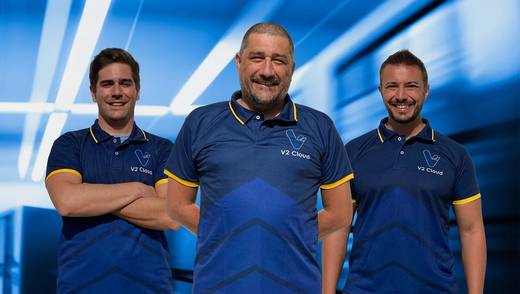
Your V2 CloudCare team — real people, on the line.


