Cloud Computing for Offshore Team Management: 8 Benefits of Implementing Virtual Desktops
September 21, 2026

September 21, 2026
Managing offshore teams can be challenging due to communication gaps, time zone differences, and difficulties accessing resources.
These obstacles often lead to delays, miscommunication, and lower productivity. Businesses need a reliable way to keep teams connected, organized, and secure.
Cloud computing solves these problems by offering centralized tools for seamless collaboration, file sharing, and real-time communication. With cloud services, offshore teams can access the same resources as in-office employees, regardless of location.
According to a Gartner report, 50% of U.S. companies now use offshore teams to stay competitive in the global market. Additionally, 94% of enterprises use cloud services to streamline operations and reduce costs.
The increasing reliance on offshore talent, combined with the adoption of cloud computing, shows the critical role cloud platforms play in modern team management.
In the tech industry, offshore development teams are typically classified based on their project service model. The three main types of offshore teams are:
These teams consist of remote developers who are brought in to support your in-house team.
This approach is often referred to as IT staff augmentation, since it focuses on temporarily extending your existing workforce with specialized skills.
The local team takes the lead on the project, while the offshore team handles specific tasks like prototyping, testing, or routine operations.
This model is ideal when you need additional resources for short-term tasks without hiring full-time staff.
Project-based teams are responsible for managing entire development projects independently.
Unlike staff augmentation, these teams are hired for one-off projects with clear requirements and timelines.
They’re typically brought in for pilot programs, testing new ideas, or handling overflow work when in-house resources are stretched thin.
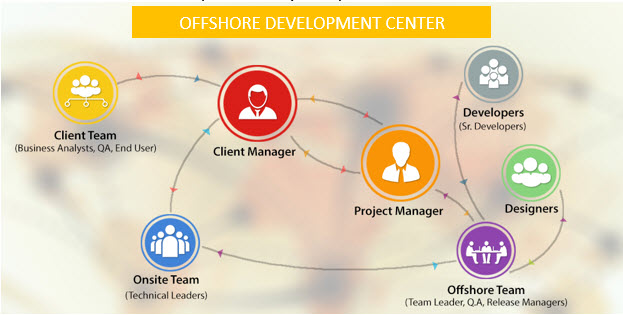
Offshore development centers operate as an extension of your in-house team but on a long-term basis. These teams are composed of dedicated experts who take on large-scale, ongoing projects.
An ODC functions like a permanent remote department, allowing businesses to leverage specialized skills without the overhead of building an internal team.

Managing offshore teams can bring many benefits, such as cost savings and access to global talent, but it also comes with several challenges.
Here are the main difficulties businesses face when working with offshore teams:
Time zone differences and language barriers can create delays and misunderstandings.
When team members are working hours apart, it can be tough to coordinate meetings, clarify tasks, or provide feedback in real time.
Impact: Poor communication leads to delays in project completion and increases the risk of errors.
Solution: Cloud-based communication tools like Slack, Zoom, and Microsoft Teams enable real-time messaging, video conferencing, and file sharing, making it easier for teams to stay connected across time zones. Where the gap is language rather than scheduling, Lara Translate handles project documentation and messages accurately, so collaboration doesn’t break down over words alone.
Offshore teams often face issues accessing company systems, documents, and other resources due to geographical and technological limitations.
Traditional IT setups can make it difficult for remote workers to log in to secure environments.
Impact: This can lead to downtime, inefficiency, and slow progress.
Solution: Cloud computing platforms, such as V2 Cloud, provide secure remote access to files, apps, and virtual desktops, enabling offshore employees to work as efficiently as in-house staff.
It can be difficult to track offshore team members’ progress and productivity when they work remotely.
Without the right tools, managers might lack visibility into how work is progressing, which tasks are completed, and where bottlenecks are happening.
Impact: This lack of oversight can lead to missed deadlines and low productivity.
Solution: Cloud-based project management tools like Asana, Trello, and V2 Cloud’s virtual desktop solutions provide real-time tracking of tasks and team progress, helping managers maintain visibility and accountability.
Offshore teams handle sensitive data, which raises security concerns, especially when data is shared across borders.
Without the right safeguards, data can be vulnerable to breaches or unauthorized access.
Impact: A data breach can have legal and financial consequences, damaging the company’s reputation.
Solution: Cloud platforms offer built-in security features like data encryption, multi-factor authentication, and role-based access control, ensuring that only authorized team members can access sensitive information. V2 Cloud, for example, complies with industry standards to protect your data.
Cloud computing does more than just solve the challenges of offshore team management—it also provides several key advantages that can transform how your teams work.
Businesses can effectively manage offshore teams, improve communication, and reduce costs while maintaining security and productivity.
Simple solutions like V2 Cloud’s Desktop-as-a-Service allow companies to streamline operations, ensuring that offshore teams work as efficiently as in-house staff, no matter where they are.
One of the biggest challenges offshore teams face is accessing company systems and data due to geographical distance or strict security protocols.
Without a centralized platform, employees may struggle to work efficiently, especially when they need to connect to resources hosted in different locations or on-premise servers.
Cloud computing solves this issue by enabling team members to access necessary tools, data, and applications from any location as long as they have an internet connection.
This means offshore teams can work as effectively as in-house staff, without the typical roadblocks of location-based restrictions.
Seamless access boosts productivity, reduces downtime, and enables offshore teams to work around the clock, regardless of time zone differences.
Offshore teams often face difficulties when collaboration tools are fragmented or not standardized across the organization.
In a distributed team, disjointed communication platforms, separate project management tools, and scattered file-sharing systems can lead to miscommunication, wasted time, and lost productivity.
Cloud computing brings all these elements together under a unified platform.
Whether team members are working in different time zones or on different continents, the cloud allows for instant access to shared files and updates, reducing lag and increasing project transparency.
Managers can also track progress in real time, ensuring offshore teams stay aligned with project goals and deadlines, while making it easier to give feedback and solve problems as they arise.
Offshore teams need to be flexible and scalable, especially when project demands fluctuate.
Traditional IT infrastructure makes it difficult and costly to scale rapidly, as businesses must invest in physical servers, additional storage, and more complex systems to support larger teams.
With cloud computing, however, scalability becomes much simpler and more affordable. Cloud platforms allow companies to easily add new users, increase storage, or boost computing power with just a few clicks.
There’s no need for expensive infrastructure upgrades or lengthy installation processes.
This means that as your offshore team grows, your cloud solution can scale effortlessly to meet their needs, whether you’re adding a few new team members or expanding the entire workforce.
Ensuring the security of data and systems is one of the top concerns when managing offshore teams.
With employees working from various locations, often across different countries, maintaining secure access and protecting sensitive information can be challenging.
Cloud computing provides a reliable solution by offering advanced security features that protect against data breaches and system failures while keeping workflows efficient.
Here’s how cloud computing can enhance security for your offshore teams:
Offshore teams often handle sensitive data that must be kept secure, especially when working with clients from various regions.
Cloud platforms provide robust security measures, such as advanced encryption and multi-factor authentication, to protect data both in transit and at rest.
These platforms are also designed to meet international security standards, like GDPR, ensuring your business stays compliant with global data protection regulations.
V2 Cloud, for instance, offers these security features, allowing offshore teams to collaborate without the fear of data breaches.
This ensures that your sensitive information is protected, regardless of where your team is located.
Losing data due to system failures or human error can be catastrophic, especially for offshore teams that rely on consistent access to files and projects.
Cloud computing minimizes this risk with automated backups that ensure data is regularly saved and recoverable.
This means that if something goes wrong, your team can quickly restore lost information without significant downtime.
With V2 Cloud’s automated backup system, businesses can confidently manage their offshore teams, knowing their data is secure and always recoverable, ensuring that productivity stays on track.
Managing who can access sensitive information is critical when working with offshore teams. Without clear control over who can view or modify data, there is a greater risk of unauthorized access or accidental data breaches.
Cloud platforms use role-based access control (RBAC) to assign specific access rights to different users based on their roles.
This ensures that offshore team members only have access to the data and tools they need to do their jobs.
Cloud computing offers a highly cost-effective solution for managing offshore teams, helping businesses save on infrastructure, hardware, and IT maintenance.
By leveraging the cloud, companies can optimize their operations and avoid unnecessary expenses.
Here’s how cloud computing makes managing offshore teams more affordable:
Setting up and maintaining physical infrastructure for offshore teams can be incredibly expensive.
Traditional IT setups require costly hardware like servers, data centers, and networking equipment, which also demand continuous maintenance and upgrades.
Cloud computing eliminates the need for these physical systems.
Instead of investing in on-premise servers or additional office space, businesses can use cloud services to host all their data and applications.
This reduces overhead costs significantly, as the cloud provider manages the infrastructure.
As a result, businesses can allocate their resources more efficiently, focusing on growth rather than maintaining physical hardware.
Cloud platforms operate on a pay-as-you-go model, meaning businesses only pay for the resources they actually use.
This flexible pricing structure is ideal for companies managing offshore teams because it allows them to scale up or down without significant upfront investment.
Whether you need to expand your team for a new project or reduce resources during slower periods, the cloud provides the flexibility to adjust costs accordingly.
With V2 Cloud, businesses can scale their virtual desktops, storage, and other services based on real-time needs, making it easy to manage offshore teams without overspending on unused capacity.
This ensures cost efficiency while maintaining the ability to grow and adapt as needed.
Selecting the best cloud solution for managing offshore teams is crucial to ensuring seamless collaboration, data security, and cost efficiency.
The right provider will offer the flexibility, security, and tools necessary for your business to thrive.
Here’s how to evaluate cloud providers and make a smooth transition to a cloud-based infrastructure.
When selecting a cloud provider for your offshore team, there are several key factors to consider.
V2 Cloud simplifies offshore team management with a virtual desktop solution that provides secure, scalable access to company resources.
Its pay-as-you-go model and easy-to-use platform make it ideal for companies looking to keep costs low while ensuring seamless collaboration and security.
With built-in security features and scalable options, V2 Cloud ensures your offshore teams can work efficiently without any tech-related delays. Talk to a Cloud Expert Now!
Migrating your existing offshore team to a cloud-based infrastructure can be a smooth process with the right strategy.
Here are the key steps for a successful transition:
Cloud computing has transformed the way businesses manage offshore teams, offering solutions that address key challenges like accessibility, collaboration, security, and cost-effectiveness.
By adopting cloud technology, companies can ensure their offshore teams stay productive, secure, and connected, no matter where they are in the world.
Whether you’re looking to streamline communication, scale resources easily, or enhance data protection, cloud solutions like V2 Cloud provide the tools to make it happen.
V2 Cloud’s virtual desktop solution simplifies the management of offshore teams with a user-friendly, secure, and scalable platform designed to boost efficiency and reduce overhead costs.
Ready to take your offshore team to the next level? Talk to a Cloud Expert Today and experience seamless, secure, and cost-effective team management.
Your V2 CloudCare team — real people, on the line.


