Why Open-Source Linux VMs Offer Unparalleled Transparency and Control
August 28, 2025

August 28, 2025
While living on a rollercoaster of cyber-attacks and regulatory audits, the last thing any IT leader needs is a black box. Yet, many of us are still forced to manage critical infrastructure with a “trust us" mindset.
Proprietary virtualization stacks, with their closed-source code and opaque security models, leave a lot to faith. And faith, as we all know, doesn’t stand up in an audit.
This is the core problem that open-source Linux VMs solve. They’re the answer to the dreaded “How do you know this is secure?" question.
Linux VDI and VM deployments offer the kind of granular control you usually only dream of. With them, you get complete, auditable visibility from the kernel to the application layer.
With the desktop virtualization market projected to exceed $25.24 billion by 2030¹, and Linux already powering over 66% of virtualized workloads², the conversation is shifting.
Open-source Linux VMs aren’t just a cost-saving measure; they’re a strategic investment in transparency, control, and operational freedom. Proprietary stacks operate on a trust model, but trust is a fragile thing, especially when it’s not backed by verifiable proof.
A Linux VM, on the other hand, is a fully transparent, open platform. This provides three critical advantages for IT managers and CISOs:
This is the very philosophy that drives platforms like V2 Cloud’s Linux-based virtual desktop solutions.
V2 Cloud has taken the power and transparency of the open-source Linux ecosystem and packaged it into an enterprise-grade, managed VDI solution. You don’t have to sacrifice reliability or professional support to get the benefits of an auditable, vendor-neutral stack.
The thought of a malicious backdoor hidden in a third-party library is a very real threat. Proprietary software often provides no way to verify its components, making you a passive recipient of potential vulnerabilities.
Open-source Linux VMs turn this model on its head. The entire codebase is public. Every component, from the bootloader to your core applications, can be inspected, verified, and customized.
Kernel Configuration Review: Your kernel’s .config file is a definitive manifest. It’s a version-controlled document that lets you see exactly what’s compiled into your system.
Organizations can examine every enabled feature, security module, and driver to ensure compliance with security policies. This level of transparency allows security teams to verify that unnecessary attack surfaces are eliminated and required hardening measures are implemented.
Did a developer enable a module they shouldn’t have? Is a security feature accidentally disabled? With Linux, you can answer these questions with a single command, not a support ticket.
Build Reproducibility: This is your silver bullet against supply chain risks. Reproducible builds mean you can take the exact same source code, compile it on a different machine, and get an identical binary.
Using deterministic build environments and pinned dependencies, teams can validate that distributed binaries match their source code exactly. This capability is essential for supply chain security and regulatory compliance, where software provenance must be verified.
If the hash doesn’t match, you know something’s wrong. This is a proven method to guarantee the integrity of your software.
Provenance Evidence: Software Bills of Materials (SBOMs) aren’t a new concept, but they’ve become a critical requirement for regulatory compliance.
Organizations generate machine-readable inventories of all software components, their versions, licenses, and dependencies. These artifacts provide auditors with complete visibility into the software supply chain and enable automated vulnerability scanning against known databases.
This machine-readable manifest provides auditors with a complete inventory of your software stack, including versions, licenses, and dependencies. It’s the kind of verifiable provenance that makes compliance a fact, not a hope.
Transparency without control is just a report you can’t act on.
Linux VMs enable precise control from kernel parameters to user-space services, allowing organizations to implement defense-in-depth security strategies tailored to their specific requirements.
This granular control extends across all system layers.
Kernel hardening includes sysctl parameters tuning, LSMs (Linux Security Modules: a framework in the Linux kernel that allows enforcement of mandatory access control policies), minimal module loading, and cgroups/namespaces isolation.
Organizations can disable unnecessary kernel features, enforce strict memory protections, and implement container-style isolation even for traditional VMs.
Example sysctl hardening keys include:
Service governance through systemd unit policies enables socket activation, sandboxing, and resource limits for every service.
Administrators can implement least-privilege principles by restricting filesystem access, network capabilities, and system calls for individual services. A compromised application can’t escape its sandbox, which significantly limits the damage it can do.
Network posture control through nftables/iptables baselines and eBPF policies enables least-privilege network access.
Organizations can implement microsegmentation, traffic filtering, and behavioral monitoring at the kernel level, providing visibility and control that traditional firewalls cannot match.
One of the biggest headaches with VDI is the licensing model. The per-seat costs of proprietary OS and VDI brokers can make a scalable deployment a non-starter.
Linux VDI eliminates per-seat OS licensing, giving you a transparent cost model that scales predictably and avoids long-term vendor dependency.
This predictable cost structure is exactly why V2 Cloud offers its Linux-based virtual desktop solution. By building on open-source, they bypass the inflated licensing fees of legacy VDI providers, passing the savings—and the control—on to you.
Deploying a Linux VDI on your own is complex.
The expertise required to build and maintain these systems can be a significant barrier. This is the primary trade-off you face: the unparalleled transparency and control of Linux versus the operational complexity of managing it.
This is exactly where a managed solution shines. V2 Cloud provides an enterprise-grade platform that takes on this operational burden.
They offer long-term support, pre-validated distributions, and managed services that allow you to harness the power of Linux without needing a team of kernel engineers. It’s how you get the benefits of open-source transparency with the peace of mind of a professionally managed service.
Ready to see how simple it can be? Learn more about how V2 Cloud’s Linux VMs deliver enterprise-grade VDI with none of the hassle.
Can Linux VMs achieve FIPS 140-3 validation, and how is this configured?
Yes. Many enterprise Linux distributions are FIPS-validated. This is configured by enabling FIPS mode, which forces the system to use only FIPS-certified cryptographic modules. The configuration is auditable and can be verified to prove compliance.
How do I enable measured boot and Secure Boot with a Linux VM using vTPM?
First, attach a vTPM device and enable Secure Boot in the VM’s firmware. Measured boot then collects cryptographic hashes of the boot components.
By binding disk encryption keys to these values, you ensure that if the boot process is ever tampered with, the vTPM will detect it and prevent the keys from being released, securing your data.
How do Linux VDI deployments restrict copy-paste and file redirection for data loss prevention?
This is handled at the remote protocol level. You can configure policies to disable or restrict clipboard, USB, and file redirection, ensuring sensitive data never leaves the secure VM.
What is the process to generate and store an SBOM for a Linux golden image?
The process should be automated within your CI/CD pipeline. Use tools to generate SBOMs in standard formats like SPDX or CycloneDX.
The SBOM is then cryptographically signed and stored alongside the image in a secure registry, providing a verifiable record for auditors and procurement teams.
SQ Magazine. Linux Statistics & Trends 2025.
https://sqmagazine.co.uk/linux-statistics/
Market.us. Thin Client Statistics and Trends.
https://scoop.market.us/thin-client-statistics/
Ace Cloud Hosting. Virtual Desktop Infrastructure (VDI) & DaaS Statistics. https://www.acecloudhosting.com/blog/stats-about-vdi-daas/
LLCBuddy. Desktop as a Service Providers Statistics. https://llcbuddy.com/data/desktop-as-a-service-providers-statistics/
Consegic Business Intelligence. Virtual Desktop Market Insights. https://www.consegicbusinessintelligence.com/virtual-desktop-market
Mordor Intelligence. Desktop Virtualization Market – Industry Report. https://www.mordorintelligence.com/industry-reports/desktop-virtualization-market-industry
SQ Magazine. Cloud Computing Statistics 2025. https://sqmagazine.co.uk/cloud-computing-statistics/
OpenPR. Desktop Virtualization Market Size and Key Insights 2025. https://www.openpr.com/news/4139996/desktop-virtualization-market-size-and-key-insights-2025
The CTO Club. Best VDI Solutions: Tools Overview. https://thectoclub.com/tools/best-vdi-solutions/
The Business Research Company. Virtual Desktop Infrastructure Global Market Report. https://www.thebusinessresearchcompany.com/report/virtual-desktop-infrastructure-global-market-report
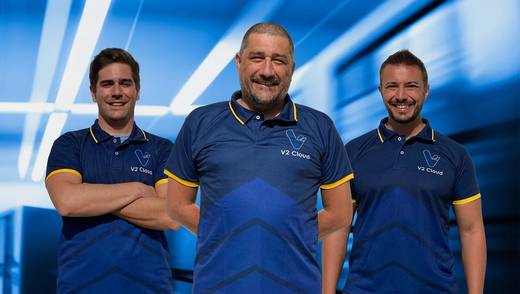
Your V2 CloudCare team — real people, on the line.


