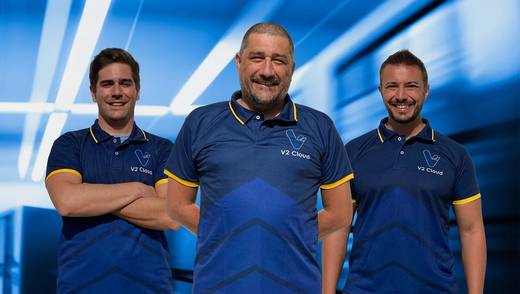
We are excited to join the SHRM Conference 2026 along with HR’s brightest leaders to discuss the future of the workplace.
Drop by V2 Cloud’s booth #2260 at the SHRM Conference 2026 as we define the future of work with HR-packed insights from top experts, AI advancements, developing regulations, and practical tactics for navigating a fast changing workforce.

The Digital Workspace Revolution
Yes, HR leaders are expected to do far more than recruit and retain talent, today. They are increasingly involved in workforce technology decisions, employee experience initiatives, security discussions, compliance programs, and digital transformation projects. In many organizations, HR and IT are working more closely together than ever before.
What accelerated as a remote work solution during the pandemic has matured into a strategic workforce technology. Today, virtual cloud computing beyond Desktop-as-a-Service (DaaS) enables organizations to streamline onboarding, improve employee experience, support flexible work models, strengthen security and compliance, and maintain business continuity in an increasingly distributed world.
HR Challenges Are Growing More Complex in 2026
The demands placed on HR teams continue to increase.
7 in 10 business leaders say their primary competitive strategy over the next three years is to be fast and nimble, to quickly adapt to and capitalize on changing business, customer, or market needs.
Employees asking for real workplace flexibility
Real workplace flexibility is more than just choosing where to work; it is also about allowing your staff to choose their own hours and figure out the best approach to achieve their objectives.
DaaS enables employees to securely access their work environment from almost any device with an internet connection. What’s more is that V2 Cloud supports complete computing resource environments to include all of the files, databases, applications, and servers that round out all of the tools that employees use.
This flexibility helps organizations:
- Support remote employee
- Enable hybrid work arrangements
- Improve workforce mobility
- Reduce location-based hiring restrictions
- Expand talent pools
Most importantly, instead of relying exclusively on physical devices that must be configured, shipped, managed, and secured individually, organizations can provide employees with secure cloud-based workspaces that are accessible from virtually anywhere.
For HR ( and Accounting) teams, the benefits of building a digital workspace are substantial.
Accelerating Employee Onboarding
One of the most common frustrations during onboarding we invite you to discuss with us during the SHRM Conference 2026 is the delay between hiring an employee and getting them fully productive.
Traditional onboarding often requires multiple steps:
- Ordering hardware
- Configuring devices
- Installing applications
- Setting up user permissions
- Shipping equipment
- Troubleshooting access issues
Every delay affects employee experience and slows time-to-productivity.
With DaaS, organizations can provision complete work environments in minutes. New hires can receive secure access to a fully configured Windows® desktop containing all required applications, settings, and resources and be up and running within the first minutes of their first day.
Whether hiring locally, nationally, or globally, employees can begin working immediately in their digital workspace without waiting for equipment delivery or lengthy IT setup processes.
Simplifying Contractor and Temporary Workforce Management
Managing technology access for short-term workers often creates administrative burdens. Issuing company-owned hardware, configuring systems, and ensuring proper offboarding can consume significant resources.
Virtual computing simplifies this process dramatically. Organizations can quickly provision secure cloud desktops for temporary workers and revoke access instantly when engagements end.
The result is:
- Faster workforce scaling
- Improved access control
- Reduced equipment costs
- Simplified offboarding – no data to retrieve
- Better security for external workers
For staffing firms, healthcare organizations, contact centers, professional services firms, and other organizations with dynamic workforce needs, these digital workspace capabilities can significantly improve operational efficiency and security.
Supporting Workforce Transformation and AI Adoption

Organizations across industries are exploring how employees can leverage AI-powered tools to improve productivity and automate routine tasks. HR leaders are increasingly involved in AI governance discussions because AI adoption affects workforce development, training, policy creation, and risk management.
Virtual computing provides a centralized environment that can support AI initiatives more effectively than unmanaged endpoint devices.
Organizations can:
- Standardize AI-enabled work environments
- Control application access
- Manage security policies centrally
- Reduce shadow IT risks
- Simplify governance and oversight
As AI becomes more deeply integrated into workplace operations, centralized computing environments can help organizations balance innovation with control.
Integrating Security Into Every Corner of Your HR Stack
Security has become a major concern for HR leaders.
HR teams are involved in discussions about cybersecurity, employee privacy, insider threats, workforce security policies, and organizational risk management.
HR departments routinely handle highly sensitive information, including:
- Employee records
- Compensation information
- Benefits data
- Performance reviews
- Personally identifiable information (PII)
- Healthcare-related documentation
- Payroll records
Protecting this information is critical.
DaaS solutions offer security advantages that are difficult to achieve with traditional endpoint-centric computing models. Users can interact with applications and data inside a secure cloud environment. In many cases, the actual data never resides on the endpoint device.
This significantly reduces the organization’s attack surface.
Faster and More Secure Offboarding
Employee departures represent a significant security risk.
Traditional offboarding processes may involve recovering devices, removing local data, disabling accounts, and ensuring that access privileges are fully revoked.
Any delay can create vulnerabilities. Virtual computing simplifies offboarding by centralizing access control.
Organizations can immediately:
- Disable user access
- Revoke permissions
- Remove application access
- Prevent future logins
Because data remains centralized, the concern about sensitive information remaining on employee devices after separation is mitigated and the costs for automated tools to retrieve or lockout data from BYOD devices is avoided.
Reducing Risk from Broken, Lost or Stolen Devices
Physical devices are frequently lost, stolen, damaged, or misplaced.
In traditional environments, these incidents can result in substantial security concerns if sensitive data is stored locally.
Virtualization minimizes this risk. If a laptop is lost, the organization’s data remains protected within the cloud environment rather than on the device itself.
This provides significant peace of mind for organizations handling confidential employee or customer information.
Supporting HR Compliance Objectives
Compliance remains one of the most significant concerns facing HR departments.
Organizations must navigate an increasingly complex landscape of regulations governing employee records, privacy, data protection, retention requirements, and information security.
On top of the GAAP requirements that all companies face and the SOX regulations for publicly-traded companies, depending on industry and geography, organizations may need to address requirements associated with:
- HIPAA
- SOC 2
- GDPR
- PIPEDA
- FINRA
- SEC regulations
- State privacy laws
- Industry-specific governance frameworks
Failure to maintain compliance can lead to significant financial, legal, and reputational consequences but virtual computing providers
Virtual computing can play an important role in supporting compliance initiatives by providing an easy path to programmatic backups for long-term archiving.
Improving Access Management
Many regulatory frameworks require organizations to limit access to authorized users and maintain appropriate controls over sensitive information.
Virtual computing supports these requirements through:
- Role-based access controls
- Centralized authentication
- User permission management
- Session monitoring
- Access revocation capabilities
Organizations can more easily demonstrate that access is restricted to authorized personnel.
Enhancing Auditability
Auditors often seek evidence showing how information is accessed, managed, and protected.
Virtual computing environments frequently provide centralized logging and monitoring capabilities that improve visibility into user activity.
This can support:
- Compliance reporting
- Internal audits
- Security investigations
- Governance reviews
- Cyber insurance requirement audits
Centralized visibility often makes it easier to produce the documentation and evidence auditors require.
Supporting Data Retention and Governance Policies
Many organizations must comply with retention requirements for employee records, communications, and business documentation.
Virtualization supports broader governance strategies by reducing uncontrolled copies of data across numerous endpoint devices and we would recommend discussing this at the SHRM Conference 2026.
Centralized environments make it easier to implement:
- Retention policies
- Data lifecycle management
- Access restrictions
- Information governance controls
These capabilities can strengthen compliance programs while reducing administrative complexity.
Meet V2 Cloud at the SHRM Conference 2026
We are keen to discuss all the above mentioned issues at the SHRM Conference 2026 and help you build a flexible, more secure and efficient workplace that responds to your business and employee needs.
Today, workforce experience, security, compliance, AI adoption, remote work, onboarding efficiency, and business continuity are all interconnected. As a result, HR leaders are becoming increasingly influential stakeholders in workforce technology decisions.
Virtual computing is no longer just an IT infrastructure discussion. It is a strategic workforce enablement solution that helps organizations create more flexible, secure, productive, and compliant work environments.
Stop by the V2 Cloud booth #2260 at the SHRM Conference 2026, talk to our experts and discover how virtual computing can help your organization build a more secure, agile, and future-ready workforce. Come for the cookies and stay for the insights into modern workforce management.