Multi-year contracts made sense when Desktop as a Service (DaaS) was a young, infrastructure-heavy technology. Vendors needed commitment to justify the build-out. That logic has largely expired since then and now you can partner with top DaaS providers with no long-term contracts.
The market is crowded, provisioning is fast, and your headcount doesn’t wait 36 months to change. Signing a long-term DaaS contract today mostly locks you into pricing that stops working the moment you scale up, downsize, or switch business direction.
The good news: several top DaaS providers with no long-term contracts that now offer month-to-month billing or short-term commitments without stripping out enterprise-grade features. The harder part is knowing which “flexible" claims are real and which are annual contracts dressed up in monthly billing language.

Three years ago, IT teams evaluating DaaS were mostly asking: Does it work? Can it handle our applications? Is it secure enough?
Those questions still matter. But a different question has moved up the priority list: what happens if our situation changes six months from now?
The answer depends entirely on what you signed. A 36-month DaaS contract with a large vendor looks reasonable on a spreadsheet at the time. Then you acquire a company. Or lose a major client. Or migrate half your workforce to a different region. Suddenly you’re paying for 200 desktops when you need 80, and your exit clause requires 90-day written notice plus a termination fee.
The financial argument for contract flexibility is straightforward. DaaS removes the hardware capital expenditure. The whole point is to convert fixed costs into variable ones. A rigid multi-year commitment partially defeats that logic before you even log in.
A 2024 Global Interconnection Index report found that by 2026, an estimated 80% of new enterprise digital infrastructure spending will be subscription-based. Organizations aren’t just moving to the cloud. They’re specifically moving toward models that let them adjust spend as conditions change. A DaaS contract that punishes you for adjusting is swimming against that current.
There’s also a competitive argument. The DaaS market has matured quickly. According to Statista, the global Desktop as a Service market is on track to reach $9.88 billion by 2029, growing at roughly 16% per year. More vendors mean more options. More options mean you have leverage. Use it.
Before evaluating specific providers, a clarification is worth making.
“Monthly billing" is not the same as “no contract." Many DaaS vendors bill month-to-month but still require an annual commitment. You get an invoice every 30 days. You also get an exit fee if you leave before 12 months are up.
Watch for these patterns:
Annual commit with monthly invoicing. You’re billed each month but committed for the year. Missing that distinction is one of the most common traps buyers fall into. The billing frequency is monthly. The contract length is not.
Auto-renewal clauses. Some providers renew your contract automatically for another year unless you cancel within a specific window (often 30 to 90 days before the renewal date). If you miss that window, you’re committed for another full term regardless of whether you intended to stay.
Per-desktop vs. per-user minimums. A few vendors require you to maintain a minimum number of desktops regardless of actual usage. Scaling down doesn’t reduce your bill unless you renegotiate, which typically requires another commitment.
Price increases locked to multi-year terms. Some providers offer month-to-month billing at a meaningful premium (18% or more above annual rates). The flexibility is real but it comes with a cost that deserves honest evaluation.
Genuine contract flexibility means: you can add seats without renegotiating, remove seats with reasonable notice, and exit without paying a termination penalty. That’s the standard worth measuring against.
V2 Cloud is built around a flat-rate monthly pricing model with no long-term contracts and no hidden fees. You pay per user, per month. You can scale the number of desktops up or down as your team changes, and there’s no penalty for leaving.
That structure was a deliberate product decision. Our platform is designed for SMBs and mid-market teams who can’t afford to be locked into infrastructure contracts that outlive their actual business needs. An accounting firm adding seasonal staff during tax season shouldn’t need to renegotiate a three-year agreement to do it.
We deploy cloud desktops in under 20 minutes, support MFA and SSO out of the box, and include 24/7 technical support across chat, email, and phone in every plan at no additional charge. Our 99.99% uptime SLA means roughly 4.4 hours of potential downtime per year. For teams evaluating us before committing, we offer a 7-day demo.
Pricing is transparent and visible on our pricing page. No sales call required to get a number.
What this means: Month-to-month billing that’s genuinely month-to-month, not annual commitment dressed up with monthly invoices.
Amazon WorkSpaces offers two billing options with no annual contract required for either: monthly and hourly.
Monthly billing gives you a flat fee per desktop per month, billed at the end of each calendar month. Hourly billing charges a smaller base infrastructure fee plus a per-hour rate for actual usage, making it well suited for part-time workers or contractors who don’t need full-time desktop access.
With monthly billing, you pay a fixed monthly fee for unlimited usage during the month. If a WorkSpace is launched after the first calendar day of a month, the price is adjusted on a pro rata basis. If a WorkSpace is terminated before the end of a month, the monthly charge still applies for that final month.
Hourly billing works best when desktops are used, on average, for less than a full working day, generally four hours or less per day. Monthly billing is better for users who need full-time access. You can mix billing types across your user population and switch between them at any time during a billing period.
The tradeoff with WorkSpaces is complexity. Costs stack across compute bundles, Windows licensing (RDS SAL), storage, and public internet bandwidth. Getting to a clean per-user number takes more work than it should. For organizations already embedded in AWS, that overhead is familiar. For those who aren’t, it adds friction.
No long-term commitment is required, but the pricing model rewards careful monitoring to avoid unexpected charges.
Azure Virtual Desktop (AVD) doesn’t come with a standalone subscription fee, you pay for the underlying Azure compute, storage, and networking resources your desktops consume. That consumption-based model means there’s technically no annual contract for the AVD service itself.
In practice, most organizations deploy AVD through a Cloud Solution Provider (CSP) or Microsoft partner, and those partners typically structure their own agreements. Some offer month-to-month arrangements. Others bundle AVD into annual Microsoft 365 or Azure Committed Use deals that create de facto long-term commitments even if AVD itself is technically flexible.
If you already hold Microsoft 365 or Windows licenses, AVD is worth evaluating seriously because those licenses offset a meaningful portion of the cost. If you’re coming in without that existing footprint, the total cost of ownership calculation becomes significantly more involved.
What this means: Flexible in theory, complex in practice. Contract terms depend heavily on how you procure and through which partner.
Citrix DaaS uses a subscription model, and monthly billing is technically available. The practical reality for most buyers looks different.
Citrix’s SLA commitments apply to customers who have purchased services using a term-based subscription with a 1-year minimum subscription period and at least a 100-unit subscription. Below those thresholds, you’re outside the SLA coverage entirely.
Citrix’s push toward annual and multi-year commitments means organizations must lock in large portions of their budget, limiting their ability to address unforeseen expenses or pivot their strategies.
The inability to exit or renegotiate licensing agreements mid-term poses a significant challenge, if an organization outgrows its Citrix license or decides to transition to another provider, it loses the financial investment made in its current contract.
For enterprise buyers with 100+ seats who intend to stay on the platform long-term, Citrix DaaS is a serious option. Multi-year commitments typically unlock 15 to 30% discounting compared to annual contracts. That discount is real. But it comes at the cost of exit flexibility.
For SMBs or any organization that wants genuine month-to-month optionality, Citrix is a difficult fit. The product is built around enterprise scale and enterprise commitment structures.
Dizzion offers more billing flexibility than most enterprise DaaS vendors, though the structure rewards commitment.
The Dizzion DaaS service is available in subscription periods of 1 month, 1 year, and 3 years. Customers can prepay for the entire committed subscription term or choose to be invoiced monthly or annually.
All base pricing is built around prepaid annual terms. Monthly annual commit increases costs by approximately 9%, while month-to-month pricing increases costs by approximately 18%.
Month-to-month is genuinely available. You’ll pay a meaningful premium for it. For organizations that need flexibility above cost optimization, that premium may be acceptable. For those running tight margins and expecting consistent headcount, annual prepay will produce better economics.
Dizzion also offers Flex Credits, a consumption-based model that lets you prepay for compute and reallocate desktops without modifying your contract. That’s a useful feature for organizations whose desktop needs shift frequently across projects or teams.
| Provider | Minimum Term | Monthly Billing Available? | Month-to-Month Premium | Best For |
| V2 Cloud | None | Yes | None (flat monthly pricing) | SMBs, mid-market teams, no-commitment buyers |
| Amazon WorkSpaces | None | Yes (monthly or hourly) | No premium — hourly available for low-usage users | AWS-embedded organizations, variable usage workloads |
| Azure Virtual Desktop | Depends on CSP | Via CSP partner | Varies by partner agreement | Existing Microsoft 365 / Azure customers |
| Citrix DaaS | 1 year (for SLA coverage) | Technically yes, but annual is standard | Meaningful (annual unlocks 15–30% discount) | Large enterprises, 100+ seat deployments |
| Dizzion | 1 month | Yes | ~18% above annual prepay rate | Teams needing flexibility who can absorb the premium |
Not locked into a long-term contract but still want enterprise-grade cloud desktops? Our flat-rate monthly pricing includes 24/7 support, daily backups, and a 7-day demo with no commitment required.
Vendor conversations tend to move quickly once procurement gets involved. These questions slow things down in a useful way.
If the answer is “annual," the monthly rate you’re seeing in the pitch deck is not the price you can pay month-to-month. Get the true month-to-month rate in writing.
Many contracts renew automatically. The cancellation window is sometimes as short as 30 days before renewal. Miss it and you’re in for another full term.
Make sure there are no hidden terms and that your vendor doesn’t hold data in escrow or charge export fees. Know the exit process before you’re in it.
Support tiers, bandwidth, additional storage, MFA integration, and backup features all appear as line items in some vendor agreements. Get a complete cost picture, not just the per-user rate.
Some contracts specify a fixed seat count. Scaling up requires a new agreement, which often resets your commitment clock.
A 99.9% uptime SLA sounds solid. Read the remedies section. Some providers offer service credits worth a fraction of the monthly fee, with multi-month failure patterns required before you’re even eligible to claim them.
Before signing anything, talk to one of our cloud experts. We’ll walk through your specific use case and give you a straight answer on whether we’re the right fit with no pressure, no multi-year pitch.
Contract terms vary by vendor and segment. Enterprise-focused providers like Citrix typically require a 1-year minimum to access SLA coverage, and their incentive structures push buyers toward 3-year agreements.
SMB-oriented providers, including V2 Cloud, offer genuine month-to-month billing with no minimum term. The industry average across all segments sits somewhere between 12 and 24 months, but that average skews heavily toward larger enterprise deals.
It depends on the provider. Some vendors, like V2 Cloud, use flat monthly pricing with no premium for month-to-month billing. Others, like Dizzion, charge an 18% premium above annual prepay rates for month-to-month flexibility. Amazon WorkSpaces doesn’t charge a premium for not committing annually, though its billing complexity can produce unexpected costs if usage isn’t monitored carefully.
Month-to-month DaaS typically means a fixed per-user monthly fee with no multi-year commitment. Pay-as-you-go (or hourly billing, as Amazon WorkSpaces calls it) means you’re charged based on actual usage hours. Pay-as-you-go works well for contractors or part-time workers. Month-to-month flat pricing is better for full-time employees who need consistent desktop access.
Yes. Enterprise features like MFA, SSO, automated backups, 99.95% uptime SLAs, and 24/7 support don’t require a multi-year contract. We include all of those in our standard month-to-month plans. The idea that enterprise capabilities require enterprise commitment structures is a vendor preference, not a technical necessity.
Four things deserve close attention: auto-renewal clauses and their cancellation windows; minimum seat requirements that prevent you from scaling down; separately billed components (support, bandwidth, backups) that inflate the true monthly cost; and SLA remedy terms that require prolonged failure patterns before you can claim any credit.
V2 Cloud is built specifically for SMBs and offers flat monthly pricing with no minimum term and no long-term commitment. Amazon WorkSpaces is another option if you have AWS familiarity, though its billing complexity can be a barrier for smaller IT teams. Citrix and most enterprise-first vendors are harder fits for small businesses looking to avoid commitment structures.
For most SMBs, yes, provided you test with real applications and real users rather than a scripted walkthrough. The critical variables (application compatibility, latency to your region, support responsiveness) reveal themselves quickly under actual use.
We offer a 7-day demo specifically because we find buyers can reach a confident decision within that window. If you need longer, talk to us, we’d rather you be certain than rushed.
For more on how Desktop as a Service compares to traditional VDI, and what to expect from each model, see our overview of virtualization solutions. If you’re evaluating options specifically for a smaller team, our VDI for small businesses page covers what matters most at that scale. You can also see a direct breakdown of how we compare to other providers.
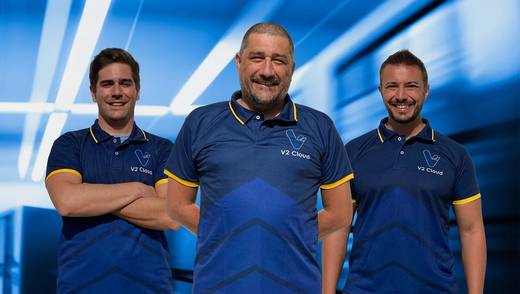
Your V2 CloudCare team — real people, on the line.