What’s Really Slowing Down Engineering Projects (and How To Fix It)
March 14, 2026

March 14, 2026
Last updated: 2025-10-06
Despite the optimistic estimations of industry experts in 2024, the construction industry in 2025 is filled with considerable challenges, such as immigration policies, tariffs, and federal spending cutbacks. However, construction professionals don’t only come face-to-face with external factors they have no control over.
They also deal with internal challenges such as cyber threats, inefficient workflows, and a lack of IT resilience that slow down their projects, resulting in major bottlenecks. Therefore, addressing them promptly is critical for the future of their business.
Engineering projects are significantly slowed down by pervasive financial risks, poor data quality, and high operational costs. A major cause is weak project control, leading 86% of construction companies to experience cost overruns.
Furthermore, cyber threats pose an escalating financial burden, with ransomware attack recovery costs estimated at $1.53 million as of June 2025. These systemic inefficiencies also contribute to professional dissatisfaction, as 69% of architects and engineers report experiencing burnout. A more structured approach to operations, including robust workforce management systems, can improve resource planning, mitigate burnout, and increase project delivery success rates.
A significant lack of real-time visibility into crucial elements such as schedules, resource allocation, and overall costs frequently hinders engineering projects.
This issue is often compounded by teams working in silos, which inevitably leads to ineffective communication and a severe lack of coordination among the stakeholders. The direct consequences include frequent misunderstandings, the need for extensive rework, and ultimately, missed deadlines.
Furthermore, the lack of visibility fosters uncontrolled budget creep, where expenses escalate beyond initial projections, and resources are allocated inefficiently. These accumulated problems ultimately prevent the team from achieving its project milestones.
This challenge is pervasive, and the statistics reveal just how detrimental it is. 86% of construction companies experience cost overrun, mainly due to inadequate planning, inaccurate cost estimation, and payment delays. This high percentage profoundly affects both project success and financial stability in the industry.
Construction environments are inherently Volatile, Uncertain, Complex, and Ambiguous (VUCA). Engineers and architects frequently operate across various sites and disciplines, often relying on siloed tools and physical devices with local storage.
This dependence creates significant vulnerabilities, as these devices are susceptible to damage or loss, frequently interrupting workflows. Without real-time, cloud-based communication, information becomes fragmented, outdated, or inconsistent across stakeholders, leading to critical errors and widespread miscommunication.
As a result, engineers and architects deal with “bad data"—inaccurate or untimely information—which has proven financially catastrophic for the industry, resulting in global losses of $1.8 trillion in 2020. (Autodesk and FMI Corp. study, 2021)
Such breakdowns inevitably cause versioning errors, duplicated work, and project delays, further straining already tight budgets. Construction delays lead to penalties that not only increase costs but also harm a contractor’s reputation, undermining client trust and jeopardizing future partnerships.
The construction industry is considered an easy target for cyber threats. The cybersecurity vulnerabilities due to its high reliance on physical devices and limited IT support make construction companies prone to damage and hacking.
Unlike other sectors, cloud-based data storage and protection software are not yet common, leaving critical information exposed. A major factor contributing to ransomware attacks is a lack of expertise, which results in 40.2% of the victims. Another vulnerability is the undetected security gaps, a factor in 40.1% of attacks. (Sophos State of Ransomware, 2025)
Digital workflows, particularly those involving sensitive AutoCAD and BIM files, are prime targets. When accessing these files online, it’s also important to understand how to clear browser history and other local traces after use to reduce unnecessary exposure on shared or unsecured devices. Additionally, crucial data like client contracts, blueprints, and financial documents are susceptible to cyber threats, risking unauthorized access and data loss.
The consequences of these vulnerabilities are severe, including data breaches, ransomware demands, intellectual property theft, regulatory fines, and a significant loss of client trust.
Small and mid-sized businesses in the construction sector struggle with a significant lack of in-house IT resources. When the proper IT policies are not implemented, a company’s growth and IT resilience are severely impacted. This is often due to limited knowledge about cloud-based solutions, a shortage of specialized IT staff, and the perceived complexity of setting up secure systems that enable effective collaboration and efficient workflows.
Without robust IT resilience, these businesses are highly vulnerable to failures caused by hardware outages, cyber incidents, or natural disasters. Such disruptions lead to extended downtime, the loss of critical data, interrupted collaboration, and missed project milestones.
This can lead to disruptions in business continuity, revenue loss, and issues with contractual compliance. Consequently, these firms are slower to patch vulnerabilities, adopt new tools, or effectively respond to system outages.
Ransomware attacks pose a persistent threat to construction companies, often halting operations for extended periods. Recovery costs from ransomware alone are estimated at $1.53 million as of June 2025 (Sophos State of Ransomware Report, 2025).
Beyond monetary losses, these incidents lead to significant downtime, legal penalties, and severe damage to a company’s reputation and client trust. A stark example is the sophisticated ransomware attack on a Glasgow-based engineering firm. The cyber attack forced the shutdown of core systems and resulted in delayed shipments worth over £50 million in revenue, with an estimated incident cost of up to £5 million.
Such events highlight how cyberattacks can expose sensitive project data, jeopardize safety-critical systems, and ultimately threaten the future of the business.
The Architecture, Engineering, and Construction (AEC) industry struggles with retaining professionals, primarily due to prevalent burnout and systemic inefficiencies. A recent Engineering Management Institute survey revealed that 69% of architects and engineers reported experiencing burnout, primarily stemming from inefficient workflows and processes. (Engineering Management Institute Survey, February 2024)
Beyond burnout, several key factors contribute to high turnover rates within the AEC sector:
These statistics collectively highlight a critical need for the AEC industry to re-evaluate its operational structures, leadership strategies, and workload management to foster a more sustainable and engaging environment for its professionals.
Hardware outages, cyber incidents, and natural disasters can severely disrupt collaboration and project milestones. Hence, the critical need for robust IT resilience becomes evident across professionals in the AEC industry.
IT resilience refers to an organization’s capacity to maintain operations, access vital project data, and collaborate effectively despite technical failures or cyberattacks. When IT resilience is lacking, AEC firms deal with fragmented tools and siloed data, leading to breakdowns in coordination, slowed decision-making, and increased rework.
Specifically, limited resilience prevents engineers and architects from accessing crucial project documents promptly, especially on mobile devices, which hinders field collaboration and real-time decision-making.
Weak IT resilience also causes:
Ultimately, without strong IT resilience, even minor disruptions can cascade across multiple stakeholders. Consequently, AEC firms deal with extended downtime, loss of critical project files, contractual penalties, and significant revenue loss, which jeopardize business continuity and profitability. For trade professionals, adopting modern tools like roofing contractor software can streamline scheduling, job tracking, and field coordination—delivering greater efficiency across every phase of a construction project.
Weak project control, inefficient communication, and persistent cyber risks exacerbate the financial losses within the AEC industry. Firms that dismiss these serious inefficiencies as merely “part of the job" are at a major disadvantage, risking falling behind competitors who have embraced more resilient systems.
This complacency can lead to substantial project delays, budget overruns, and a damaged reputation, making it harder to secure future contracts. However, the good news is that tailored solutions exist to help AEC businesses not only stay afloat but also maintain a crucial competitive edge and achieve their strategic business goals in an increasingly complex landscape. These solutions address the core pain points, helping them turn operational weaknesses into strengths.
Virtual Desktop Infrastructure (VDI) offers a centralized platform for the AEC industry for seamless collaboration and workflow transparency.
This technology significantly enhances workflows, project control, and communication by ensuring all stakeholders, whether in the office, on-site, or remote, have consistent access to up-to-date project data and design files like AutoCAD or BIM models.
Such centralization is designed to reduce version conflicts, rework, and miscommunication. Furthermore, VDI provides unparalleled flexibility and mobility, allowing engineers and architects to access their complete desktop environments from any device.
Lean thinking significantly benefits engineers and architects by enhancing workflow efficiency and minimizing miscommunication. This methodology establishes continuous, synchronized workflows, reducing waste and delays through value stream identification, optimal flow, pull planning, and continuous improvement.
It fosters predictable workflows, better resource utilization, and improved collaboration across all project phases. By breaking down information silos with digital tools and regular meetings, lean principles reduce errors and misunderstandings.
In fact, 23% of firms report they are taking steps to improve job site performance with lean construction techniques. (AGC Survey, 2019)
To fully optimize site performance, the reliability of the heavy machinery supporting daily operations is just as critical as the workflow itself. Adopting Service Pro’s equipment maintenance software helps reduce unplanned downtime, keeping physical assets aligned with lean construction goals.
When combined with Building Information Modeling (BIM), lean practices enable early error detection and smoother project management, leading to less costly late-stage changes and increased overall project success.
Lean Benefits for Engineers and Architects:
| Benefit | Outcome |
| Faster project delivery | Reduced cycle times, accelerated workflows |
| Better collaboration | Early stakeholder engagement breaks silos |
| Waste reduction | Less rework, fewer errors, resource optimization |
| Cost savings | Lower labor and material expenses |
| Improved quality | Higher design excellence and client satisfaction |
| Enhanced communication | Continuous and transparent information flow |
Multi-million dollar ransomware attacks are reduced dramatically with VDI. Safeguarding all sensitive files within the centralized infrastructure neutralizes the immediate threats of data loss and unauthorized access.
This robust approach allows all stakeholders to focus on project progress with peace of mind. Data is readily accessible across teams and meticulously protected against cyber threats thanks to rigorous security protocols and strong encryption.
Thanks to robust security measures, including rigorous protocols and strong encryption, data integrity is protected, allowing AEC teams to operate efficiently without data breach worries.
By centralizing data and applying stringent security, VDI empowers engineers and architects to collaborate seamlessly while maintaining the highest standards of data protection.
Virtual GPU provides engineers and architects with the remarkable ability to run high-performance simulations and renderings from any device. Therefore, the dependency on endpoint devices or the need for expensive, specialized hardware is eliminated.
This helps AEC teams avoid bottlenecks such as working with outdated or underpowered equipment and experiencing delays due to desktop deployment.
Here are just a few of the benefits of using V2 Cloud virtual GPU for construction professionals:
Construction firms often lack dedicated IT support, a significant advantage that cloud-hosted desktops provide.
A robust cloud solution includes comprehensive support from specialized cloud experts who manage the technical heavy lifting. At V2 Cloud, our goal is to enhance your IT resilience, allowing you to concentrate on core business operations and deliver the high-quality services your customers expect from you.
Working with a dedicated cloud expert means:
Weak project control, widespread cyber vulnerabilities, and ongoing GPU bottlenecks are just a few of the hurdles slowing AEC professionals down.
As a result, they deal with costly delays, rework, and are exposed to substantial financial losses and reputational damage.
However, a clear path forward exists. Engineering and architecture firms can achieve unparalleled efficiency by strategically implementing centralized, secure, and high-performance tools like VDI.
At V2 Cloud, we design and deliver tailored solutions to help you:
Ultimately, embracing these advanced solutions is crucial for safeguarding your future competitiveness and ensuring sustainable success in such a rapidly evolving environment.
Book a call with our cloud experts to discover the cloud-first solution your business deserves.
The top cybersecurity threats targeting architects in 2025 include ransomware attacks, data breaches, network failures, compliance risks, and poor disaster recovery planning.
Many architecture firms mistakenly believe their small size makes them safe from cyberattacks. However, statistics reveal that phishing attacks and ransomware demands target more than just large corporations. The reality is that all Architecture, Engineering, and Construction (AEC) firms are susceptible to attackers who exploit vulnerabilities such as weak entry points, unsecured cloud storage, outdated hardware, or lax authentication policies.
Project controls in engineering encompass specialized tools, techniques, and processes. These are applied throughout an engineering project’s lifecycle to plan, monitor, and control essential parameters like time, cost, scope, quality, risk, and resources. The ultimate goal is to guarantee that projects are completed on schedule, within budget, and meet the defined scope and quality standards.
Simply put, project controls help professionals systematically track project performance, manage uncertainties, and optimize resource allocation to achieve project objectives.
Five ways to secure data are encryption, antivirus and firewalls, Multi-Factor Authentication (MFA) policy, secure Cloud storage, and employee training.
Regardless of the industry, employee training in cybersecurity matters is crucial yet often overlooked. However, a layered approach is the most comprehensive and effective solution to data protection, combining physical, administrative, and technical controls.
You can prevent unauthorized access to data by prioritizing cloud-based VDI and implementing a robust disaster recovery plan. A cloud-first approach boosts operational efficiency by centralizing data, streamlining workflows, and promoting collaboration, which helps reduce errors.
Adopting cloud-first solutions like V2 Cloud significantly minimizes data loss risks, ensures business continuity, and protects financial stability, reputation, and project timelines.
VDI in engineering provides a centralized platform where engineers, architects, and other stakeholders can access updated data that leads to actionable insights. It helps AEC professionals secure all project data, design files, and applications in the cloud.
Additionally, VDI simplifies IT management and can be configured with adequate computing resources to support high-performance CAD, BIM, and simulation tools.
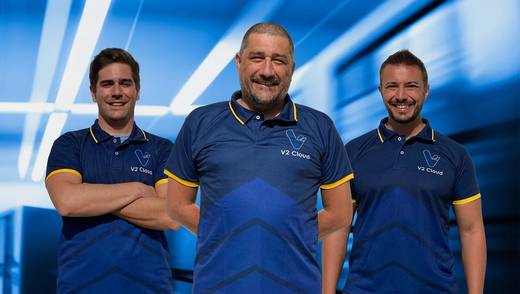
Your V2 CloudCare team — real people, on the line.