9 Leading Zero Trust Security Solutions for Access Control and Network Security
August 29, 2025

August 29, 2025
Managing insider threats, ensuring secure remote access, implementing strict access controls, and staying compliant with data protection regulations are some of the most pressing challenges organizations face today.
With increasing data breaches costing organizations millions and damaging reputations, the traditional perimeter-based security model is no longer sufficient.
The shift to remote work has expanded the attack surface, making it critical for organizations to adopt a more robust approach: zero trust security.
Explore the essential components of zero-trust security solutions and how V2 Cloud can help your organization effectively implement this advanced security model.
Zero trust security is a cybersecurity framework designed to protect modern digital environments by assuming that no entity can be trusted by default, whether inside or outside the network. This approach mandates continuously verifying every user and device attempting to access network resources.
The zero trust model is built on “never trust, always verify." Unlike traditional perimeter-based security models, which rely on a secure network boundary, zero trust operates under the assumption that threats can exist both inside and outside the network.
Therefore, strict user identity verification, granular access controls, and continuous monitoring are required to ensure that only authorized users and devices can access critical resources.
By adopting zero trust security, organizations can significantly reduce the risk of data breaches, protect against insider threats, and ensure secure remote access. This model is particularly effective in today’s landscape, where the increasing use of cloud services and remote work has expanded the attack surface and rendered traditional security models insufficient.
Zero trust security is built on several fundamental elements to create a robust defense against modern cyber threats. Below are the key components of a zero-trust model:
Identity verification and authentication are the cornerstones of zero-trust security. Making sure users are who they say they are prevents unauthorized access, which is why many organizations rely on a dedicated identity verification provider like iDenfy. Combined with multi-factor authentication (MFA) and single sign-on (SSO), this layered approach creates a stronger defense against unauthorized entry.
MFA requires users to provide two or more verification factors, significantly reducing the risk of compromised credentials. It can also be strengthened with step-up authentication, which adds extra verification only when a login attempt appears suspicious.
Network segmentation involves dividing a network into smaller, isolated segments to reduce the attack surface. This approach ensures that the rest of the network remains secure even if one segment is compromised.
Micro-segmentation takes this a step further by creating secure zones within segments. Tools like software-defined networking (SDN) and advanced firewalls enable organizations to implement and manage these segments effectively, limiting attackers’ lateral movement.
Monitoring and analyzing user behavior is crucial for detecting insider threats. Advanced analytics and machine learning can identify unusual patterns and potential risks, allowing organizations to take prompt action.
User and Entity Behavior Analytics (UEBA) tools analyze user activities in real time, flagging any deviations from normal behavior that might indicate a security threat. This proactive approach helps mitigate risks posed by malicious or negligent insiders.
Continuous monitoring and auditing are essential for maintaining a zero-trust environment. Real-time visibility into network activities enables organizations to detect and respond to threats quickly. Automated auditing tools help ensure compliance with security policies and regulations by regularly reviewing access logs and security configurations.
Continuous monitoring tools like SIEM (Security Information and Event Management) systems provide comprehensive insights into security events across the network.
Implementing strict access control policies ensures users have the minimum necessary access to perform their duties. Role-Based Access Control (RBAC) assigns permissions based on user roles, ensuring that individuals only access resources relevant to their responsibilities.
The Principle of Least Privilege (PoLP) further restricts access, allowing users to perform their tasks without exposing sensitive information. Regularly reviewing and updating access controls is vital to adapt to organizational changes and emerging threats.
With the rise of remote work, secure remote access has become more important than ever. Solutions such as Virtual Private Networks (VPNs), Secure Access Service Edge (SASE), and Zero Trust Network Access (ZTNA) provide secure connections for remote users.
VPNs, including no-log free VPN options, create encrypted tunnels for secure data transmission, while SASE integrates network security functions into a unified framework. ZTNA offers granular access controls, ensuring remote users can only access authorized applications and data.
Reducing the cyberattack surface involves minimizing the points where an attacker can infiltrate the network. This includes regularly updating software to patch vulnerabilities, removing unused services and applications, and implementing strong endpoint security measures.
Endpoint Detection and Response (EDR) solutions provide advanced capabilities to detect, investigate, and respond to threats at the endpoint level. Regular vulnerability assessments and penetration testing help identify and address potential weaknesses in the network.
By integrating these key elements, organizations can build a comprehensive zero-trust security model that effectively protects against modern cyber threats. This approach ensures that every access request is scrutinized, minimizing the risk of data breaches and unauthorized access.
Implementing zero trust architecture requires a comprehensive approach, involving multiple layers of technology and policy. Below are some of the key solutions that form the foundation of an effective zero-trust security model:
Implementing zero trust involves multiple layers of technology and policy, each playing a vital role in ensuring comprehensive protection. Below, we explore some of the leading solution providers in the zero-trust security space.
These companies offer robust, scalable, and integrated solutions to help organizations mitigate risks, secure remote access, and protect sensitive data against evolving cyber threats.
Choosing the right partner for your zero-trust security implementation is crucial. Here’s why V2 Cloud stands out as the ideal choice:
V2 Cloud’s virtual desktop infrastructure (VDI) solution offers secure remote access, daily backups, antivirus protection, and 24/7 monitoring. Our integrated approach ensures that all your security needs are met in one package, simplifying your security management and enhancing your protection.
We prioritize your privacy and compliance with data protection regulations. Our VDI solutions include advanced security measures to protect your data and ensure compliance with industry standards such as HIPAA and PCI DSS, on a GDPR-aligned platform. This guarantees that your organization meets the necessary legal and regulatory requirements.
Our flexible VDI solutions can scale with your business needs. Whether you’re a startup or an enterprise, V2 Cloud provides the resources you need when you need them. This scalability ensures that your IT infrastructure can grow alongside your business without compromising on performance or security.
Our partnerships with high-tech data centers worldwide ensure fast and secure access to cloud computers, regardless of your users’ location. This global reach allows your organization to effectively support remote and distributed teams, ensuring optimal performance and reliability.
You don’t need to be a tech expert to set up and manage your virtual desktops. Our support team is available seven days a week to assist you with any technical issues. We provide comprehensive support to ensure your VDI environment runs smoothly and securely.
At V2 Cloud, we believe in straightforward pricing with no hidden fees or long-term contracts. You pay only for what you need, with no surprises. This transparent pricing model allows you to manage your IT budget effectively while accessing top-tier security solutions.
By choosing V2 Cloud, you ensure your organization adopts a robust zero-trust security model supported by a comprehensive, secure, and scalable VDI solution.
Adopting a zero-trust principle is essential for protecting your organization’s data and network. Implementing robust identity verification, network segmentation, continuous monitoring, and secure remote access can significantly reduce the risk of data breaches and insider threats.
V2 Cloud offers a comprehensive solution that integrates these critical elements, providing a secure, scalable, and compliant VDI platform tailored to your needs.
Talk to a Cloud Expert Now to take the first step towards a more secure and efficient network with V2 Cloud. Ensure your organization is protected with a cutting-edge security model that evolves with the ever-changing cyber threat landscape.
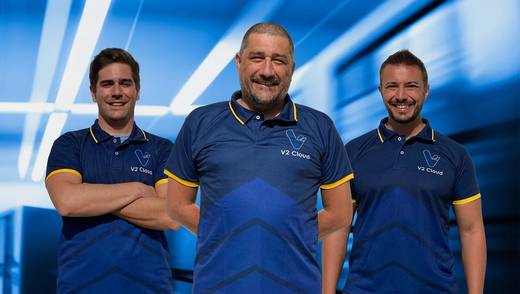
Your V2 CloudCare team — real people, on the line.


