Move DELMIAWorks to the Cloud As Is | V2 Cloud

DELMIAWorks Hosting

Why DELMIAWorks customers are moving their deployments to V2 Cloud

There is no cloud edition of DELMIAWorks. Manufacturers are modernizing the infrastructure that runs it instead. V2 Cloud hosts your existing DELMIAWorks deployment without changing the application, database, workflows, or user experience—eliminating aging server infrastructure while reducing administration, improving resilience, and simplifying long-term operations.

Built for manufacturers that depend on DELMIAWorks every day.

99.95% uptime SLA · 25,000+ active users · No long-term contracts
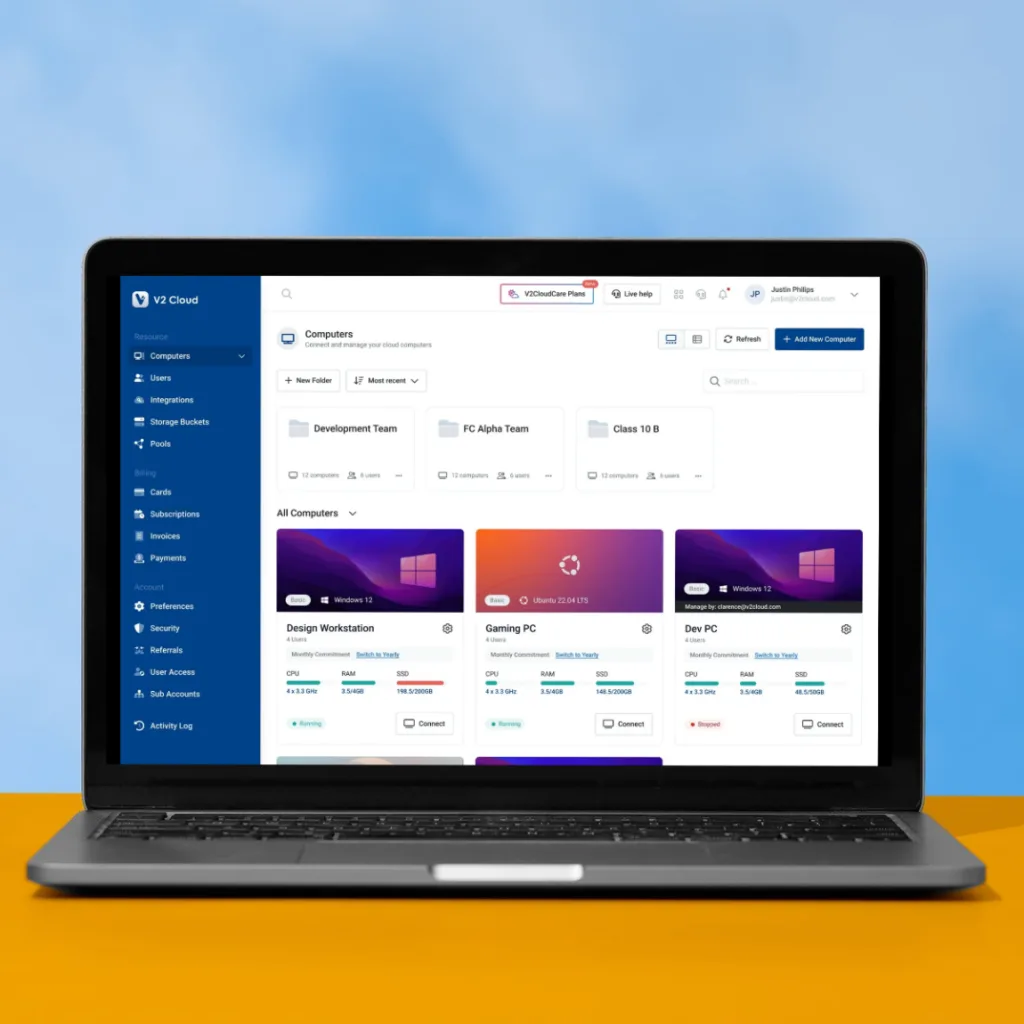
V2 Cloud dashboard

The Situation

Modernize DELMIAWorks without changing DELMIAWorks.

DELMIAWorks remains an on-premises ERP platform. Organizations seeking cloud benefits are responsible for modernizing the infrastructure themselves. As servers age, IT teams inherit increasing responsibility for hardware lifecycle management, backups, disaster recovery, security, operating system maintenance, and business continuity—without changing the ERP application itself.

Legacy infrastructure increases operational risk

Production ERP environments often remain in service well beyond their original hardware lifecycle. Aging servers increase the likelihood of component failures, extended recovery times, rising maintenance costs, and unplanned downtime that directly impacts manufacturing operations.

ERP infrastructure competes for limited IT resources

Maintaining DELMIAWorks infrastructure requires continual attention to Windows Server administration, SQL Server maintenance, storage, backups, monitoring, patching, virtualization, and hardware planning. For many manufacturers, these responsibilities fall on already overextended IT staff supporting the entire business.

Downtime impacts the entire manufacturing operation

When DELMIAWorks becomes unavailable, production scheduling, inventory management, purchasing, shipping, finance, and shop floor operations are affected simultaneously. Infrastructure resilience is no longer simply an IT concern—it is fundamental to operational continuity.

Recovery procedures are rarely validated

Many organizations perform regular backups but have limited opportunity to fully test disaster recovery procedures. Recovery objectives often depend on undocumented processes, aging infrastructure, and institutional knowledge rather than repeatable operational practices.

What This Actually Is

This is not an ERP migration. It’s a change in where DELMIAWorks is housed.

Moving DELMIAWorks to V2 Cloud does not require replacing your ERP system or reimplementing your business processes. Your existing application, SQL database, customizations, integrations, and workflows remain intact while the underlying infrastructure is modernized.

Users continue working in the same DELMIAWorks environment they know today. What changes is the platform supporting it: enterprise cloud infrastructure, managed operations, automated backups, high availability, proactive monitoring, and centralized security.

What comes off your plate the day you move

Infrastructure lifecycle management

Server hardware, operating system maintenance, capacity planning, storage, infrastructure monitoring, and lifecycle management become part of the managed service. Your team retains administrative control of DELMIAWorks while eliminating much of the underlying infrastructure burden.

Security and business continuity

Multi-factor authentication, Single Sign-On, encrypted connections, automated backups, disaster recovery capabilities, and hardened cloud infrastructure provide stronger protection than many legacy on-premises environments while supporting regulatory and customer security requirements.

Proactive monitoring and performance management

The platform is monitored continuously to identify capacity constraints, infrastructure issues, and performance anomalies before they impact users. Combined with a 99.95% uptime SLA, manufacturers gain greater operational predictability for business-critical ERP workloads.

Automated backup and recovery

Automated daily backups, centralized storage, and managed recovery processes reduce operational risk while simplifying business continuity planning. Recovery becomes a documented operational capability rather than an infrequently tested emergency procedure.

What moving as is looks like

V2 Cloud’s platform allowed Conest to move its existing software to the cloud without major changes to the codebase.

Christine Massone

Director of Support Services, Conest

The numbers behind V2 Cloud

25,000+

Active Users

99.95%

Uptime SLA

< 20 min

Cloud Desktop Deployment

24/7

Free Technical Support

Four steps. Zero reimplementation.

How the move works while production keeps running.

1

Assess your deployment

Take the two-minute self-assessment below, or walk through your setup on a guided call. Version, database size, integrations, user count — the details that determine timing. You get a straight answer on fit before anything moves.

2

We mount it as is

Your DELMIAWorks deployment is replicated on V2 Cloud infrastructure in its natural state. No data conversion. No configuration rebuild.

3

Test alongside production

Your team validates the cloud environment against real jobs while the on-prem system keeps running. Nothing cuts over until it earns it.

4

Cut over and hand off the keys

Users log in from any device with an internet connection and pick up where they left off. From that day, V2 Cloud handles monitoring, security, backups, and maintenance — and your old server becomes a very heavy paperweight.

Self-Assessment

Is your DELMIAWorks deployment cloud-ready?

Two minutes. A straight answer.

Answer a few questions about your current DELMIAWorks environment. If you know roughly what you run, you know enough.

  • Whether your deployment can move as is
  • What the move would involve for your setup
  • The factors that determine your timeline

Prefer to talk it through? Book a guided setup.

Questions IT managers actually ask

No. V2 Cloud mounts your existing deployment as is — same version, same configuration, same data. There is no reimplementation project and no conversion. Your users keep the workflows they already know.

It depends on your deployment. Database size, integrations, and customizations all move the needle, and anyone who quotes a timeline before seeing your setup is guessing. The two-minute assessment is the fastest way to get a real answer.

No infrastructure is failure-proof, ours included, and you should distrust anyone who claims otherwise. What changes is who carries the risk: a 99.95% uptime SLA, proactive 24/7 monitoring that catches problems before your users do, and daily automated backups. And if you’re calling at 2 a.m., support answers — free, on chat, email, and phone.

Your internet connection becomes the path to your ERP, so it deserves the same single-point-of-failure thinking as any critical machine — a second line from a different provider is the standard safeguard. And the comparison is not cloud versus perfect: a failed on-premise server also stops production, and usually takes longer to bring back.

No. Pricing is flat-rate and monthly, with no long-term contracts. If it isn’t working, you leave — which means we have to keep earning the business every month.

Still have questions?

Let us help you find the solution that fits your business.

Schedule a call
Your V2 CloudCare team — real people, on the line.
On a call now34s avg. pickup
SL FC AR MK +6

Your V2 CloudCare team — real people, on the line.

Back to top