On a call now34s avg. pickup
SL
FC
AR
MK
+6
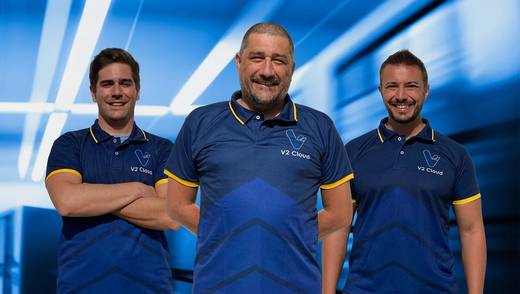
Your V2 CloudCare team — real people, on the line.
Kubernetes (κυβερνήτης) is word that dates back to ancient Greece meaning “steersman" or “helmsman." It refers to the person who navigates and steers a vessel, guiding it toward a destination by reading conditions and making constant adjustments.
That idea, of a system that observes, corrects, and stays on course, became the conceptual seed for two of the most consequential terms in modern (and cloud) computing: cybernetics and Kubernetes.
One word. Two disciplines. Thousands of years apart.
The word breaks down simply. In ancient Greek, kybernan means “to steer" or “to govern." The -etes suffix marks the person doing the action. So a kybernetes is the one who steers. The one in control.
Plato used kubernetes as a metaphor in his writing, comparing the governance of people to the piloting of a ship. The steersman doesn’t just hold the wheel. He reads the current, adjusts for wind, and constantly corrects course to keep the vessel on track. That dynamic, steady, goal-directed control through continuous feedback, is exactly what made the metaphor so useful for later thinkers.
The word traveled through Latin (gubernare, “to govern") and French (gouverner) before giving English the word “governor." That same lineage gave us “government." Steer a ship long enough in the right direction and you have a state. The metaphor ran deep.
In 1948, MIT mathematician Norbert Wiener published a book that reshaped how scientists thought about machines, animals, and communication. He called it Cybernetics: Or Control and Communication in the Animal and the Machine.The title word came directly from kubernetes.
Wiener saw the parallel clearly. A skilled helmsman monitors conditions, receives feedback, and makes real-time corrections. A living organism does the same thing through its nervous system. A machine can do it through sensors and actuators. The mechanism differs. The principle doesn’t.
He defined cybernetics as the science of control and communication in both animals and machines. The field that followed investigated feedback loops, self-regulation, information processing, and adaptation across biological and mechanical systems. It influenced control theory, systems theory, and the early foundations of artificial intelligence.
The choice of kubernetes wasn’t incidental. Wiener wanted a term that carried the idea of goal-directed behavior through feedback, and the steersman metaphor captured that precisely. You steer toward a goal. You correct when you drift. You don’t just apply force; you observe, measure, and adjust.
André-Marie Ampère, the French physicist, had already used the term cybernétique in the 1830s to describe the science of civil government. Wiener likely knew this. Either way, kubernetes was waiting for the right era to anchor a new discipline.
More than 60 years after Wiener’s book, a team of engineers at Google was building a container orchestration system. They needed a name. They chose Kubernetes, the Latinized spelling of kubernetes.
The name wasn’t random. Kubernetes manages containerized applications running across clusters of machines. It decides where workloads run, scales them up or down as demand changes, restarts failed containers, and keeps distributed systems moving toward their desired state. It steers. It corrects. It governs.
Google open-sourced Kubernetes in 2014. The following year, Google worked with the Linux Foundation to create the Cloud Native Computing Foundation (CNCF), which took stewardship of the project.
By the early 2020s, Kubernetes had become the default infrastructure layer for containerized workloads at scale. According to a CNCF report, it is the second-largest open-source project in the world after Linux, and the primary container orchestration tool for 71% of Fortune 100 companies.
The abbreviation K8s comes from the fact that there are 8 letters between the K and the s in “Kubernetes." That’s a numeronym, a shorthand common in technical communities. Kube is another common shortening. But the full word still carries the original meaning: the one who steers.
The kubernetes metaphor has survived across centuries because it captures something specific about how complex systems work well. A steersman doesn’t set a course and walk away. The job is ongoing. Wind shifts. Currents change. The steersman reads what’s happening, compares it to where the ship should be, and makes the correction.
That same loop describes every system kubernetes has named:
In distributed computing, this concept shows up in the idea of a control plane, the part of a system that makes decisions, versus the data plane, where work actually happens. The control plane is the kubernetes. It doesn’t do the rowing. It decides where the boat goes.
Kubernetes solves a specific problem: running containerized applications reliably at scale, across many machines, without requiring humans to manage each piece manually.
Before tools like Kubernetes, deploying software across dozens or hundreds of servers meant scripting everything by hand, or babysitting deployments through configuration management tools that weren’t built for containers. A container might crash. A server might go down. Demand might spike at 2 AM. Someone, or something, had to respond.
Kubernetes handles that automatically. The core use cases:
In practice, Kubernetes runs behind most large-scale web applications, SaaS platforms, machine learning pipelines, and cloud-native services. Any workload that needs to run continuously, scale on demand, and recover from failures automatically is a candidate.
The tradeoff is complexity. Kubernetes has a steep learning curve, and running it well requires real infrastructure expertise. That’s why managed Kubernetes services, like Google GKE, Amazon EKS, and Azure AKS, exist: they abstract away cluster management so teams can focus on deploying applications rather than maintaining the platform itself.
Desktop as a Service (DaaS) providers operate on the same principles. The infrastructure that delivers cloud desktops across a distributed user base involves ongoing orchestration: resource allocation, failover, scaling, load balancing, and monitoring. The underlying management systems observe current state and continuously move resources toward the desired state.
When an organization deploys cloud desktops across multiple teams, regions, and devices, the platform is doing what the kubernetes did: reading conditions, maintaining course, adjusting for disruptions. Users don’t see any of this. They just get a consistent desktop environment wherever they log in. The steering is invisible when it works.
This is also why cloud infrastructure terms like “control plane," “orchestration," and “governance" carry their weight. They’re all descendants of the same idea. Someone, or something, has to steer.
| Term | Language | Era | Meaning |
| kybernetes (κυβερνήτης) | Ancient Greek | ~400 BCE | Steersman, helmsman, pilot |
| gubernare | Latin | Classical | To govern, to steer |
| cybernétique | French | 1834 | Science of civil government (Ampère) |
| cybernetics | English | 1948 | Control and communication in animals and machines (Wiener) |
| Kubernetes | English (from Greek) | 2014 | Container orchestration system (Google) |
The trajectory is clean. A word describing a person on a boat becomes the basis for a field of science, then the name of the most widely deployed container platform in the world.
Want to explore how cloud-delivered desktops handle orchestration behind the scenes?
See how our platform manages cloud desktop infrastructure or talk to one of our cloud experts to understand how this applies to your team.
Your V2 CloudCare team — real people, on the line.