What is Cybersecurity?
Last updated: 2025-10-27
Cybersecurity encompasses a range of practices designed to safeguard computers, phones, networks, and data from malicious actors seeking to steal, damage, or misuse them. This involves protecting personal information, such as passwords and photos, by implementing robust security measures, including strong passwords, antivirus software, and established data-handling protocols.
Additionally, cybersecurity emphasizes educating individuals on secure online habits to prevent them from falling victim to scams or viruses.
Cybersecurity is a growing concern for all businesses due to our high dependence on digital systems. Cyber threats are becoming more advanced and frequent. Therefore, staying informed about evolving threats and best practices is crucial, especially since AI is used in highly sophisticated cyberattacks that are difficult to detect before they cause significant damage.
Key Takeaways
- Cybersecurity is a necessary, multi-layered defense strategy used to protect digital assets, data, and networks from sophisticated, rapidly escalating global threats.
- The human element is a critical vulnerability, as social engineering is highly prevalent, accounting for up to 98% of all cyberattacks against businesses and individuals. (SentinelOne Key Cyber Security Statistics, 2025)
- Organizations must adopt proactive security measures, such as mandatory Multi-Factor Authentication (MFA), continuous vulnerability patching, and implementation of Zero Trust principles, to enhance their security posture.
Why Cybersecurity Matters
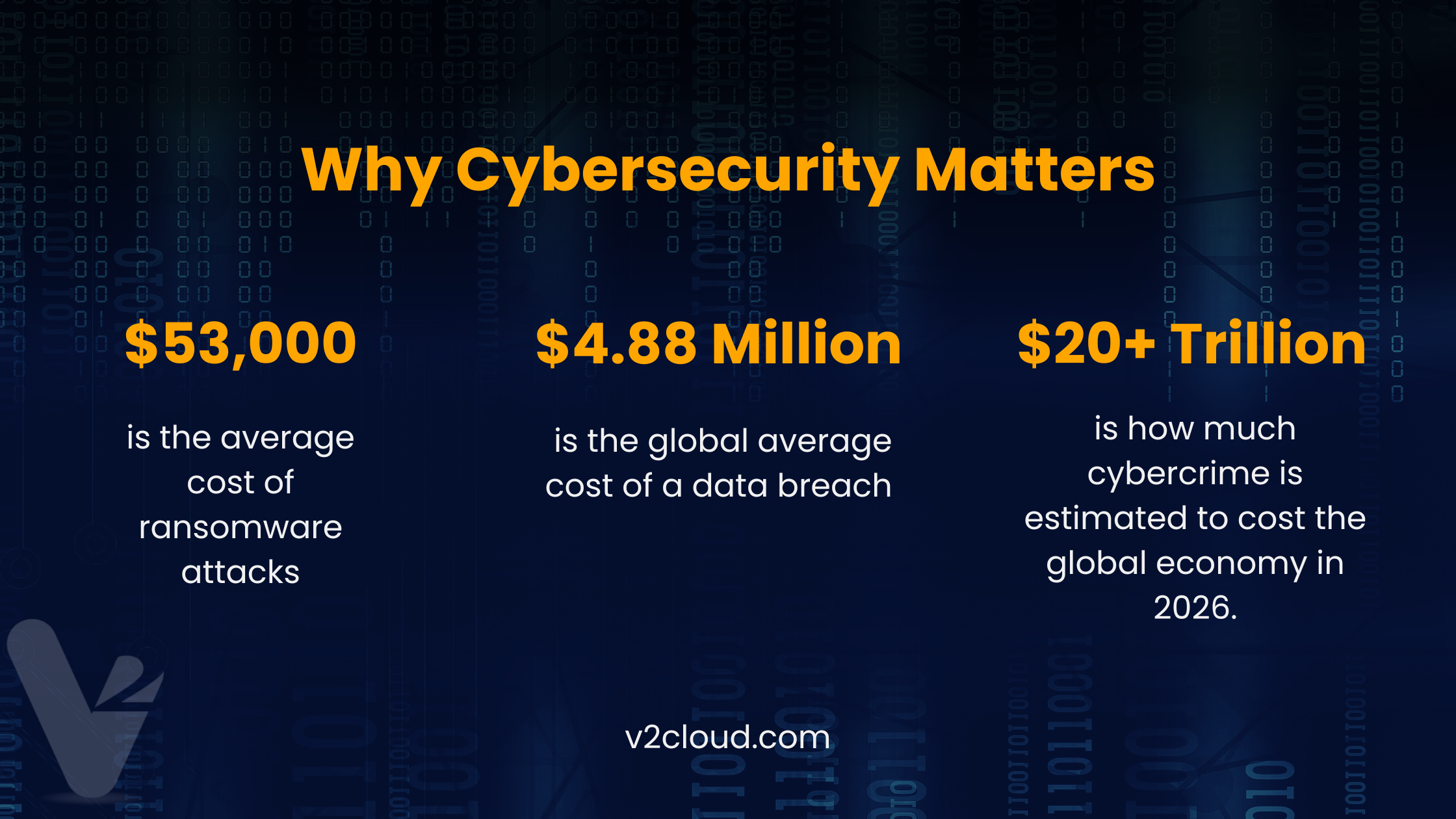
Cybercrime is a rapidly escalating global threat, projected to cost the global economy over 20 trillion U.S. dollars by 2026, a 1.5-fold increase from 2022 figures. A significant concern is the prevalence of social engineering, which accounts for up to 98% of all cyberattacks against businesses and individuals. Further compounding the challenge, encrypted threats surged by 92% in 2024, underscoring the increasing sophistication and evolving tactics of cybercriminals.
The Core Principles of Cybersecurity
Cybersecurity best practices are based on a multi-layered strategy, often thought of as its pillars and layers. These are the key parts and protective steps involved.
Cybersecurity Pillars
The pillars focus on the following core principles and objectives:
1) Confidentiality: The protection of sensitive information from unauthorized access or disclosure.
2) Integrity: Maintaining the accuracy and trustworthiness of data.
3) Availability: Ensuring systems and resources are accessible when needed.
4) Authentication: Verifying the identity of users or entities.
5) Non-repudiation: Non-repudiation ensures that a party involved in a transaction or communication cannot later deny the authenticity of their signature or the act of sending a message. In other words, non-repudiation guarantees that the origin and integrity of data can be conclusively proven, preventing claims that specific information was not sent or received.
Cybersecurity Layers
The following layers represent multifaceted defenses that achieve those principles:
- Physical Layer: This is the foundation of your network, including tangible components such as servers, switches, and physical access points. Securing these physical assets is crucial, as neglect here can lead to direct breaches.
- Perimeter Layer: Perimeter security is crucial for safeguarding your business’s digital boundaries. It manages network access, both incoming and outgoing, to stop hackers from exploiting vulnerable entry points such as email attachments or malicious websites. This security layer typically includes firewalls, intrusion detection systems, and prevention systems that scrutinize network traffic for potential threats.
- Network Layer: Network security focuses on protecting the data traveling across a business’s computer network. This includes securing all connected devices such as servers, routers, firewalls, and switches. The primary goal is to prevent unauthorized access, misuse, or alteration of data transmitted over the network.
- Endpoints Layer: Endpoint security safeguards individual devices (laptops, desktops, smartphones, and tablets) connected to your business’s network. This protection layer employs methods such as antivirus software, firewalls, and encryption to defend these endpoints against cyberattacks.
- Application Layer: Application security is vital for protecting your business’s software and applications from cyber threats. This involves adhering to secure coding practices, consistent software updates and patch management, and performing vulnerability assessments to identify and address any weaknesses. These tools must be rigorously assessed and monitored to prevent them from becoming security vulnerabilities.
- Data Layer: This security layer emphasizes the importance of regularly backing up all critical business data and implementing robust data protection measures, such as encryption and secure data storage solutions. By doing so, businesses can ensure that even in the event of a cyberattack, their essential data remains intact and recoverable.
- User Layer: Your employees are either your strongest defense or your greatest vulnerability. This layer requires building a strong cybersecurity culture and providing continuous awareness training to make security a shared responsibility.
The Major Cyber Risks
Cyberattacks are mainly executed by financially motivated organized crime actors. The most prevalent breach patterns are:
- System Intrusion,
- Social Engineering, and
- Basic Web Application Attacks.
These patterns reflect how cybercriminals combine technical exploits, human manipulation, and opportunistic attacks to breach defenses and cause disruption or financial harm.
The most common cybersecurity threats are the following:
1. Ransomware
A major component of breaches, with a significant 37% increase in 2025 compared to the 2024 report. This threat disproportionately affects smaller organizations, comprising 88% of breaches among Small- and Medium-Sized Businesses (SMBs), compared to 39% in larger organizations. Ransomware accounts for a significant portion of “System Intrusion" incidents, being implicated in 75% of such breaches.
2. Credential Theft and Abuse
Stolen credentials are one of the most common ways attackers gain initial access to networks. In fact, 31% of data breaches result from credential theft. Attackers frequently acquire these credentials from the dark web, often through malware delivered via phishing emails, and use them to log in stealthily rather than brute-force their way in.
3. Phishing Emails and Social Engineering
This cyberattack aims to exploit human vulnerabilities to cause severe financial losses, operational disruptions, and data breaches. Hackers implement these attacks by manipulating human psychology, trust, and natural tendencies to deceive individuals.
They often impersonate a trustworthy entity, such as a bank, via phishing emails to trick the victim into willingly divulging sensitive information such as passwords or credit card details. Increasingly, threat actors are leveraging Generative AI (GenAI) to create more convincing, scalable phishing emails and even deepfake voice scams (“vishing"), making these schemes harder to detect.
4. Supply-Chain and Third-Party Attacks
This type of cyber attack is involved in up to 30% of all data breaches and can cause significant consequences, such as operational disruption and data theft. Hackers implement these attacks by targeting external partners that either act as custodians of customers’ data or underpin critical parts of an organization’s operations.
5. Exploitation of Vulnerabilities
The exploitation of vulnerabilities severely impacts businesses, serving as a top initial access vector for breaches, accounting for 30% of incident response cases, and leading to significant consequences such as ransomware deployment and espionage.
Hackers exploit this by actively targeting known flaws in common public-facing applications and network devices, often using bots and automated tools to attack organizations that fail to apply patches promptly. This is particularly risky because new vulnerabilities are constantly emerging, with one new vulnerability identified every 17 minutes.
The Stakeholders & Their Responsibilities
Protecting digital assets requires commitment from all stakeholders, regardless of your job position or industry.
Executives and C-suite leaders are responsible for jointly developing and enforcing the organization’s cybersecurity strategy, using AI to predict threats and create efficient incident response plans.
CISOs must navigate the balancing act required due to growing dependence on third parties.
Security professionals and IT teams are tasked with implementing robust defensive tools like Identity and Access Management (IAM), performing network hardening, and ensuring prompt patching of software vulnerabilities.
Crucially, employees are considered the greatest vulnerability. 42% of data loss incidents occurred due to negligent insider and/or employee carelessness. Hence, continuous awareness training and mandatory Multi-Factor Authentication (MFA) are now a non-negotiable.
Best Practices & Key Strategies for Cybersecurity
Shifting from a reactive IT approach to a proactive strategic security posture will be the only way to maintain a competitive edge and overcome the evolving challenges posed by cyber threats.
Here are a few practical tactics to enhance security and develop a strong organizational culture.
1. Implement an Identity-First Strategy with Mandatory Multi-Factor Authentication (MFA)
An Identity-First strategy is crucial for managing and securing access to sensitive data and applications. A vital, yet straightforward, initial step for organizations is to implement and enforce Multi-Factor Authentication (MFA) for all employees and partners. This is considered essential for every user account, providing a critical extra layer of defense even if passwords are compromised.
2. Adopt Zero Trust Principles and the Principle of Least Privilege
More than 86% of firms adopt Zero Trust models, which emphasize that trust is never assumed, but always verified. This must be coupled with the Principle of Least Privilege (PoLP), which dictates that users are granted the minimum level of access necessary to perform their job functions, thereby minimizing the potential damage from a breach.
3. Prioritize Continuous Vulnerability Management and Prompt Patching
Since the exploitation of public-facing applications and unpatched software is a top initial access point for attackers, organizations must regularly update systems and apply patches promptly. Employing vulnerability management tools can help automate this process, and organizations can use AI to scale security patching.
4. Cultivate a Strong Security Culture through Continuous Training
The human element is a critical vulnerability involved in the vast majority of all data breaches. Continuous training and phishing attack simulations are crucial for fostering a vigilant workforce. Organizations are shifting focus toward behavioral adaptation, often leveraging GenAI to create hyper-personalized training materials, which is projected to reduce employee-caused security incidents by 40%.
5. Ensure Robust, Isolated Backups for Disaster Recovery
Backing up data serves as a vital safety net for recovery in the event of system errors or malicious attacks. Given that a high percentage of ransomware attacks specifically target backup repositories, it is essential to utilize off-site backups to ensure the recovery data is not damaged by the same event that impacts the primary system.
6. Leverage AI & Automation and Conduct Regular Audits
Investing in security automation and AI tools for quicker threat detection can significantly reduce data breach costs. Organizations that implement robust AI-powered cybersecurity measures save $1.9 million, compared to organizations that don’t.
Therefore, organizations should conduct thorough security assessments quarterly, perform lighter checks monthly, and regularly audit their IT infrastructure to prevent misconfigurations and maintain robust security proactively.

Enhance Cybersecurity with V2 Cloud
V2 CloudCare is designed to protect your data and enhance your business resilience through proactive security.
- Robust security through proactive threat detection and 24/7 threat monitoring, ensuring incidents are handled immediately rather than relying on a reactive and costly approach.
- Antivirus & threat management, SIEM & vulnerability assessments, and penetration testing.
- Proactive IT Management to detect threats and eliminate them before they cause damage.
- Seamless deployment that includes Active Directory integration and BYOD enablement, along with proactive tasks such as automated updates & patch management.
- Dedicated Customer Success Manager and 24/7 priority technical support
Our cloud experts provide the tools and strategic IT planning you need so that you can focus on your work with peace of mind.
Key Facts
- Cybercrime is estimated to cost the global economy over 20 trillion U.S dollars by 2026, a 1.5 times increase compared to figures in 2022. (Statista Cyber Crime and & Security Report, 2025)
- Up to 98% of cyberattacks – against businesses and others – involve social engineering, making this a key trend to prepare for across the next year. (SentinelOne Key Cyber Security Statistics, 2025)
- Encrypted threats increased by 92% in 2024, highlighting the growing sophistication of cybercriminals. (IBM Cost of a Data Breach Report, 2025)
- 42% of data loss incidents occurred due to negligent insider and or employee carelessness. (Voice of the CISO Report, 2024)
- 31% of data breaches are attributed to credential theft. (SentinelOne Key Cyber Security Statistics, 2025)
Cybersecurity FAQs
1. How do evolving cyber threats impact businesses financially and operationally?
The financial impact of evolving cyber threats is significant, with the global average cost of a data breach currently at approximately $4.88 million. Operationally, these incidents cause severe disruptions and downtime, including ransomware attacks that cost businesses an average of $53,000 per hour, leading to lost sales and supply chain issues.
2. What are the primary vulnerabilities that threat actors exploit to gain unauthorized access?
The primary vulnerabilities exploited by threat actors include the exploitation of public-facing applications and vulnerabilities, compromised credentials and identities, and the human element through social engineering.
3. How is AI fundamentally changing cyber threat and defense strategies?
AI is fundamentally changing cybersecurity by acting as both a powerful weapon and a critical defense mechanism. Threat actors are leveraging generative AI to accelerate and scale social engineering, phishing, and malware creation, while also exposing new attack points.
Conversely, security teams are adopting AI for automated incident detection and hunting, vulnerability prediction, and accelerated breach containment, enabling them to shift from reactive to proactive defense strategies
4. How much is cybercrime expected to cost businesses globally in 2026?
Statistics predict that cybercrime will cost the global economy more than 20 trillion U.S. dollars by 2026, a 1.5 times increase from 2022.
5. What role does human error play in cyber incidents?
Human error is one of the primary vulnerabilities that threat actors exploit to gain unauthorized access. 42% of data loss incidents occurred due to negligent insider and/or employee carelessness.
In fact, 72% of CISOs viewed human error as their organization’s most prominent cyber vulnerability. Hence, cybersecurity training is a crucial first step to safeguarding an organization’s sensitive data.